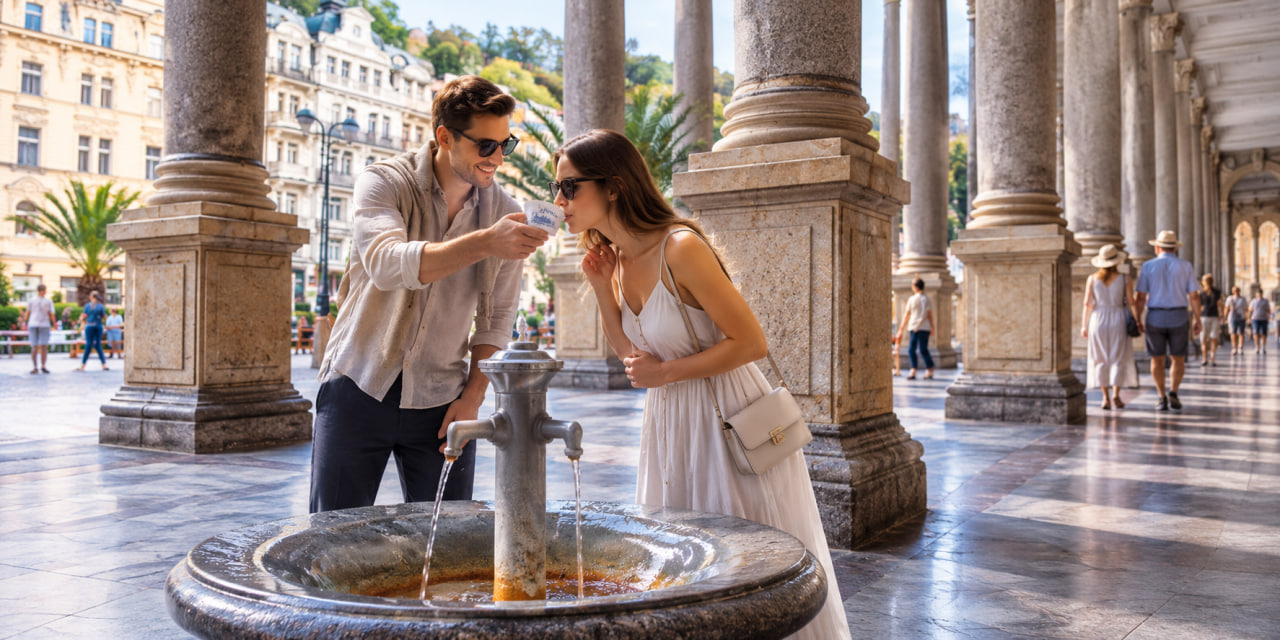
Your First Day in Karlovy Vary: Where to Start — Hour-by-Hour Guide
Karlovy Vary is a compact city. All the main colonnades fit within a half-hour walk. It sounds…
Karlovy Vary is a resort with a history going back to 1358, over 13 thermal springs rising from 2.5 kilometres underground, and UNESCO World Heritage status. It is also a city with a remarkable number of persistent myths — repeated by tour guides, tourist brochures, and travel blogs alike.
Some of these myths are harmless. Others create false expectations about why you should come and what to expect. Here are the five most common — with facts, dates, and sources.
It’s a beautiful legend often told on guided tours: Emperor Charles IV allegedly discovered a thermal spring while hunting in the 14th century, and thus the famous spa town was born.
n reality, historians confirm that the hot springs were known long before Charles IV. The first written references to the healing properties of local waters date to the 14th century, but geological evidence suggests the springs were used considerably earlier. Charles IV’s actual contribution was legal and administrative: in 1370 he granted the town of Karlovy Vary its first royal charter, giving it official status and legal foundation as a spa.
“Accidentally discovered while hunting” is a good story. The real history is more interesting: Charles IV turned already-known springs into an officially recognised resort — which is the actual founding of the city.

This belief is especially common among Russian-speaking tourists. In truth, Karlovy Vary was never exclusively “Russian.”
It’s true that in the 19th century, the town attracted Russian aristocracy — Gogol, Turgenev, Karl Marx, Peter the Great. But the same period brought Goethe (13 visits), Beethoven, Schiller, Paganini, Chopin — the list of European guests is considerably longer than the Russian one.
The town’s architecture is German and Austrian. The official language of the resort was historically German: until 1918 the city was called Karlsbad and was part of the Austro-Hungarian Empire. Russian-speaking visitors became noticeable in the 19th century — but were never the sole or even primary audience.
Today Karlovy Vary holds UNESCO World Heritage status as one of the “Great Spa Towns of Europe” — alongside Baden-Baden, Vichy, Spa, and Bath. It is a pan-European resort by history, architecture, and recognition.

One of Karlovy Vary’s best-known souvenirs is the “stone rose,” also called a “frozen rose.” Many tourists believe it’s a natural mineral found underground or a real flower that turned to stone over time.
n fact it is a handmade object — but one with genuine chemical interest. The rose starts as a paper form and is repeatedly immersed in a solution saturated with Karlovy Vary mineral salts. Through gradual crystallisation, it becomes coated in a layer of aragonite — the same “Carlsbad stone” that deposits on the pipes and walls inside the Hot Spring Colonnade.
It’s the same process you can see on the Vřídlo pipes inside the colonnade — just in decorative form.
The stone rose is not a natural mineral. But it is literally Karlovy Vary chemistry made visible — and a considerably more meaningful souvenir than a fridge magnet.
Some local Russian-speaking tours claim that scenes from the famous Soviet TV series Seventeen Moments of Spring were shot in Karlovy Vary — in Café Elefant or the Grandhotel Pupp, for instance.
There is no official confirmation of this. The series was filmed primarily at Mosfilm studios and in a number of real locations — but Karlovy Vary does not appear in the archival production documents. Some scenes were filmed in Riga; others on studio sets.
Where does the myth come from? Most likely from visual similarity: the Belle Époque architecture of Karlovy Vary, the interiors of Grandhotel Pupp and Café Elefant genuinely evoke the look of 1940s Europe. Combined with the town’s popularity among Soviet-era tourists, the association became a fixed story.
What is confirmed: Karlovy Vary was used as a filming location for Casino Royale (2006) — Grandhotel Pupp played the role of Hotel Splendide. That one is officially documented.

Walking through Karlovy Vary’s center, it’s easy to think that all the elegant buildings are centuries old. But that’s not entirely true.
A specific example: the Hot Spring Colonnade above the Vřídlo geyser is a glass-and-concrete functionalist structure from 1975, designed by architect Jaroslav Otruba. It is the third building on this site: the first was built in 1826, the second was an ornate cast-iron structure by Fellner and Helmer (1878) demolished in 1939, and a temporary wooden structure served until 1975.
The Mill Colonnade is genuinely historic — built 1871–1881. The Park Colonnade dates to 1881, the Market Colonnade to 1883. But a significant portion of the facades lining the riverbank are 20th-century reconstructions, particularly following wartime damage.
What this means in practice: the town’s architectural character is authentic in style — but not always in the actual age of individual buildings. This doesn’t make it less beautiful. It just makes it more honest to understand what you’re looking at.
Karlovy Vary doesn’t need myths. The real history — 600 years as a resort, 13 thermal springs rising from 2.5 kilometres underground, UNESCO status, an annual Category A film festival — is more interesting than most of the legends.
Understanding where myth ends and reality begins makes a visit more meaningful. The springs are more interesting when you know why the water is hot. The architecture is more interesting when you know what’s genuine and what’s reconstructed. The history is more interesting without embellishment.
The documentary “Karlovy Vary: The Power of Water“ at City Hub “Feel Karlovy Vary” on Lázeňská 14 — 60 minutes on the geology of the springs, the real history of the resort, and the science behind the drinking cure. Screenings daily at 16:00 and 20:00 in four languages
→ Vřídlo Geyser: why it shoots 12 metres high
→ Why Karlovy Vary has no 13th spring
→ What to See in Karlovy Vary: a local’s guide
→ Karlovy Vary vs Baden-Baden: comparing two UNESCO spa towns

📌 Recommended before walking the colonnades
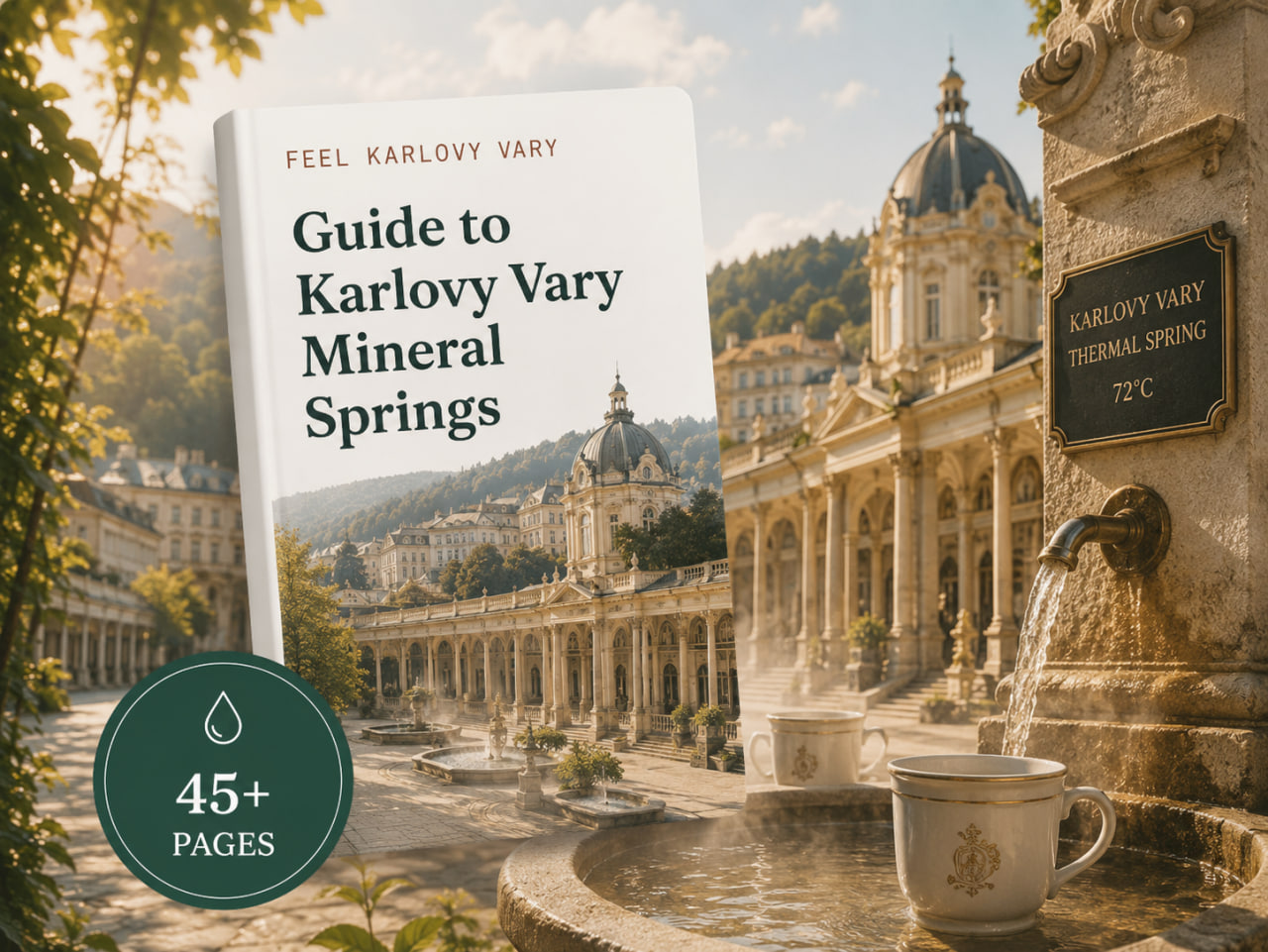
Most tourists drink from the first spring they find and move on — never understanding what it's good for or how to drink it properly.
The guide explains how the springs differ, how to choose the one that's right for you, how to drink correctly, and how to avoid wasting half a day on beginners' mistakes.
Karlovy Vary is a compact city. All the main colonnades fit within a half-hour walk. It sounds…
Karlovy Vary is one of the few resorts in the world where water from natural springs is an official…

Dresden is one of the few cities in Europe that justifies any superlative thrown at it. “Florence…