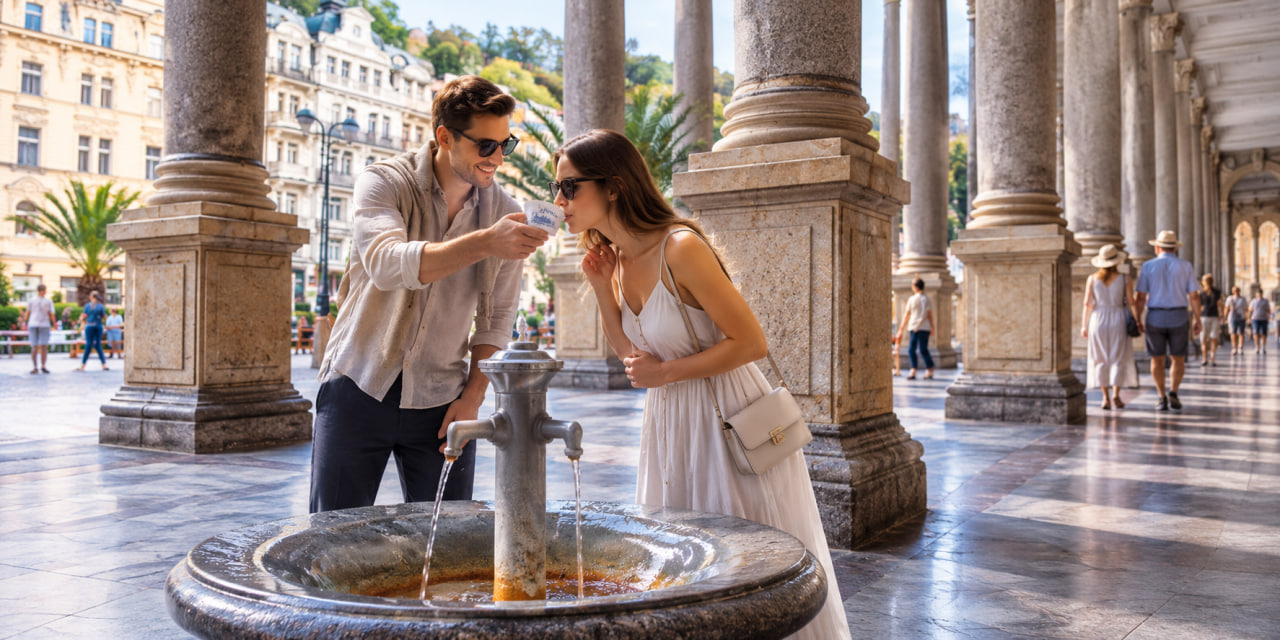
Your First Day in Karlovy Vary: Where to Start — Hour-by-Hour Guide
Karlovy Vary is a compact city. All the main colonnades fit within a half-hour walk. It sounds…
Karlovy Vary is the only resort in the world where 13 thermal mineral springs sit within walking distance of each other, along a single river, in the centre of a living city. Nothing like this exists in Baden-Baden, Vichy, or Mariánské Lázně. In two hours you can walk every colonnade, taste water at different temperatures and mineral concentrations — and understand why people come here to be treated, not just to look.
But most tourists drink at random. They approach the nearest spring, fill their cup, wince at the temperature or taste — and that’s where their encounter with Karlovy Vary’s drinking cure tradition ends. Yet every spring has its own temperature, its own level of carbon dioxide, its own traditional role in balneology — and its own history.
This guide is a complete map of all 13 springs: where each one is, what temperature it runs at, what sets it apart, what to drink and why. Including the route I walk with guests myself.
water_drop
Which of the 14 springs is right for you?
This guide shows you which of the 14 springs best suits your needs—and how to avoid common mistakes that can waste half a day.
View guide

All 13 springs of Karlovy Vary belong to a single hydrogeological body. This means their chemical composition is essentially the same: sodium-bicarbonate-sulphate thermal waters with high carbon dioxide content. Mineralisation runs at around 6 grams per litre — moderate, neither too saline nor too weak. The ionic composition has been stable for centuries — geologists check regularly and find no changes.
The composition is essentially the same across all 13 springs: sodium-bicarbonate-sulphate thermal water with high carbon dioxide content. Mineralisation runs at around 6 grams per litre — for comparison, Evian has 0.3 g/l. Karlovy Vary thermal water is nearly 20 times more mineralised than standard bottled water.
What distinguishes the springs from each other is temperature and CO₂ concentration. These two parameters determine how the water acts on the body — which is why a physician prescribes a specific spring to a specific patient, even when they look identical from the outside.
For a detailed breakdown of each spring’s composition, how temperature changes the water’s effect, and what the balneological tradition says about each one — see our complete guide to the Karlovy Vary springs.
The springs are accessible through five colonnades and several separate pavilions, distributed along the Teplá riverbank over a distance of roughly 2 kilometres. They can be walked in 1.5–2 hours, moving in one direction from the Hot Spring Colonnade to the Park Colonnade.
A modern glass and concrete building from 1975 — the youngest of the colonnade structures and the most visited. This is where the city’s main landmark is located.
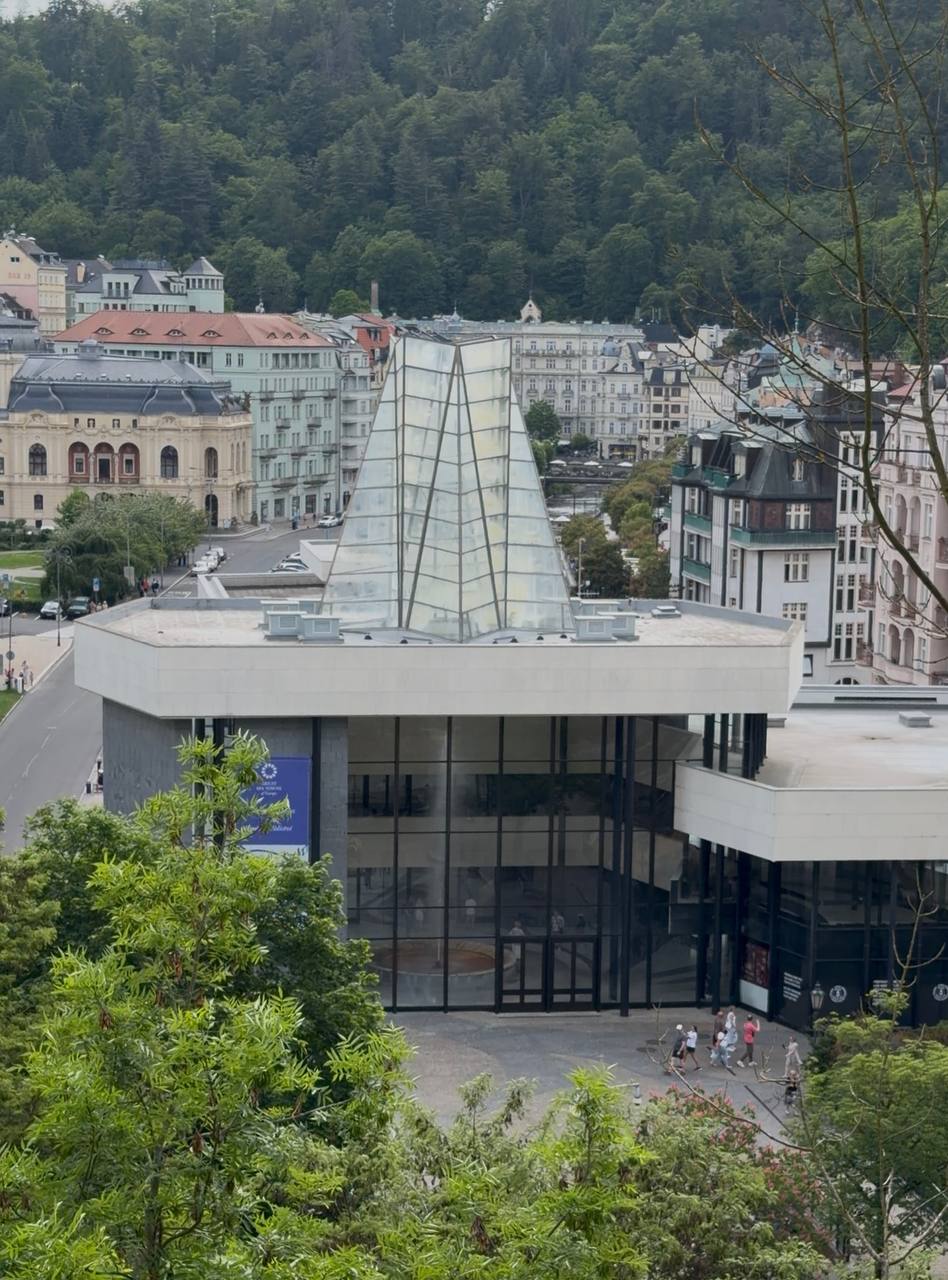
Temperature: 73°C at source. Cooled in three drinking bowls: A — 30°C, B — 41°C, C — 57°C.
Depth: water rises from nearly 2 kilometres below ground.
Flow rate: approximately 2,000 litres per minute; jet height up to 12 metres.

Vřídlo is the only true geyser among all the springs. The others emerge calmly — Vřídlo erupts under pressure. This is the source from which mineral water for all the spa baths in the city is drawn — a pipeline network distributes it throughout the resort zone.
Drinking water at 73°C isn’t possible, so the colonnade has several cooled outlets at different temperatures. Each one acts differently — and this isn’t accidental. It’s a medical system. Which outlet does what, and why it matters, is explained in the springs guide.
Guided underground tours of the Hot Spring Colonnade run regularly and are well worth it.
→ More on underground tours: Underground Tours in Karlovy Vary
A wooden gallery in Swiss chalet style, built 1882–1883 by architects Fellner and Helmer. The oldest of the active colonnades. Located 200 metres from the Hot Spring Colonnade.
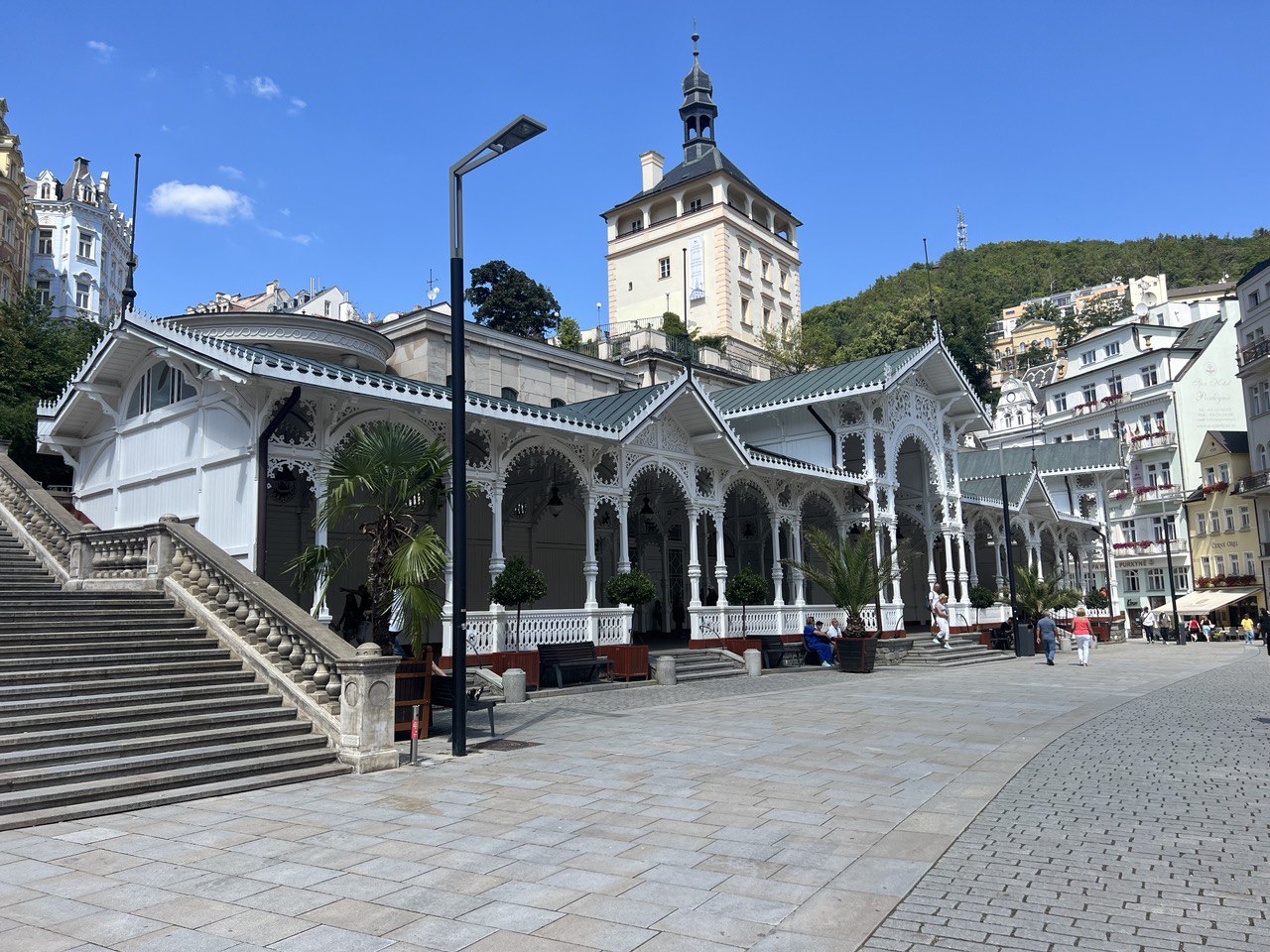
Temperature: 64–68°C.
The most historically significant spring — according to legend, this is where Charles IV discovered the healing waters in 1358, when a hunting dog burned its paw. The legend is a legend, but the fact remains: this spring is the oldest of those documented in writing. Used for digestive conditions, stimulates gastric motility.
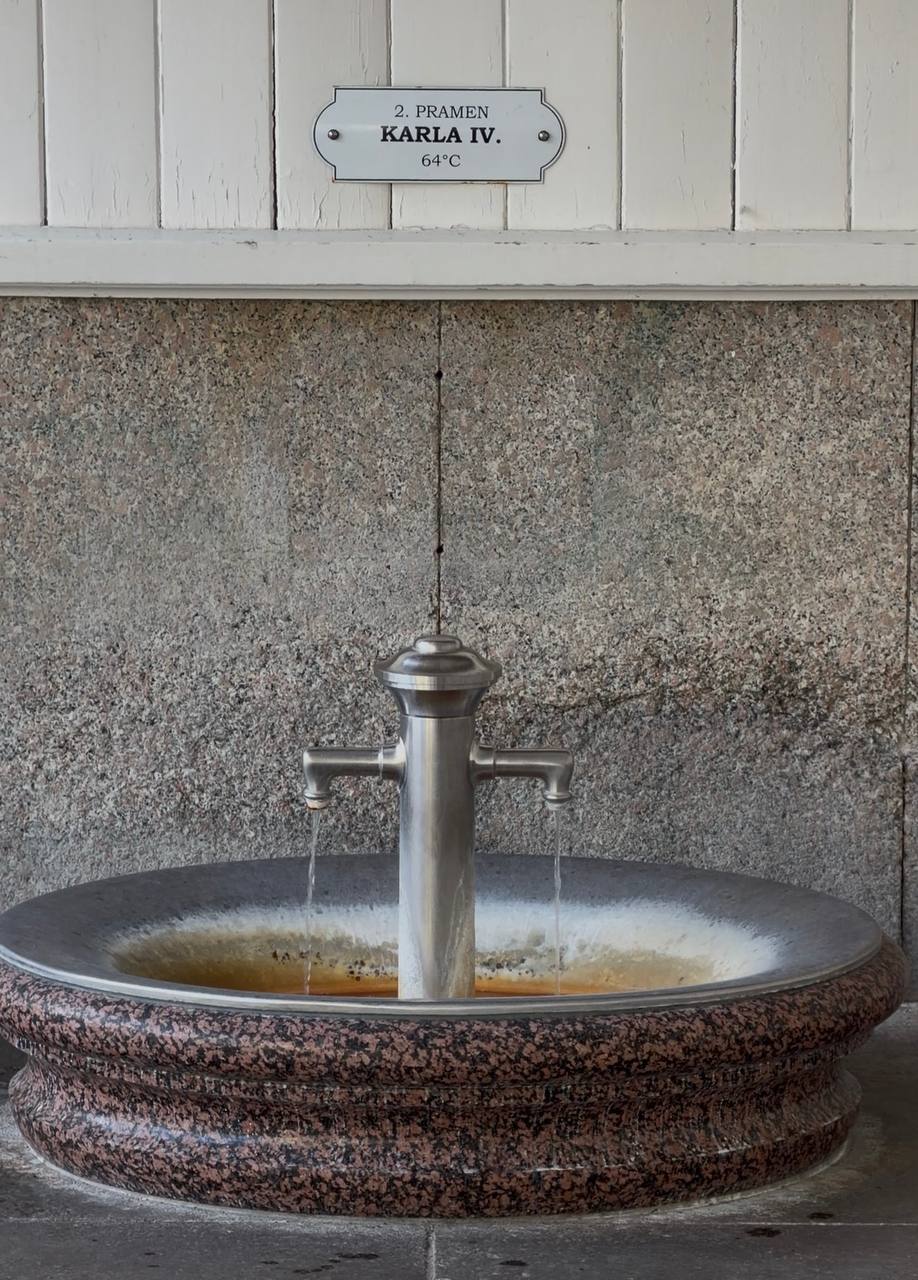
Temperature: 62–64°C.
The lower branch of the Castle Spring, diverted to the Market Colonnade — the main outlet is in the Castle Colonnade, but access there is restricted to patients of the Castle Spa. Temperature and composition are identical to the Upper Castle Spring. Traditionally used for liver and gallbladder conditions.
Temperature: 62°C.
This spring has disappeared and reappeared several times since its discovery in 1838 — geologically unstable. Named after the marketplace that stood here in the Middle Ages. Properties similar to the other springs in the colonnade.
A two-level Art Nouveau pavilion from 1910–1912, architect Johann Friedrich Ohmann. Climbs uphill from the Market Colonnade — many tourists simply don’t make it this far.
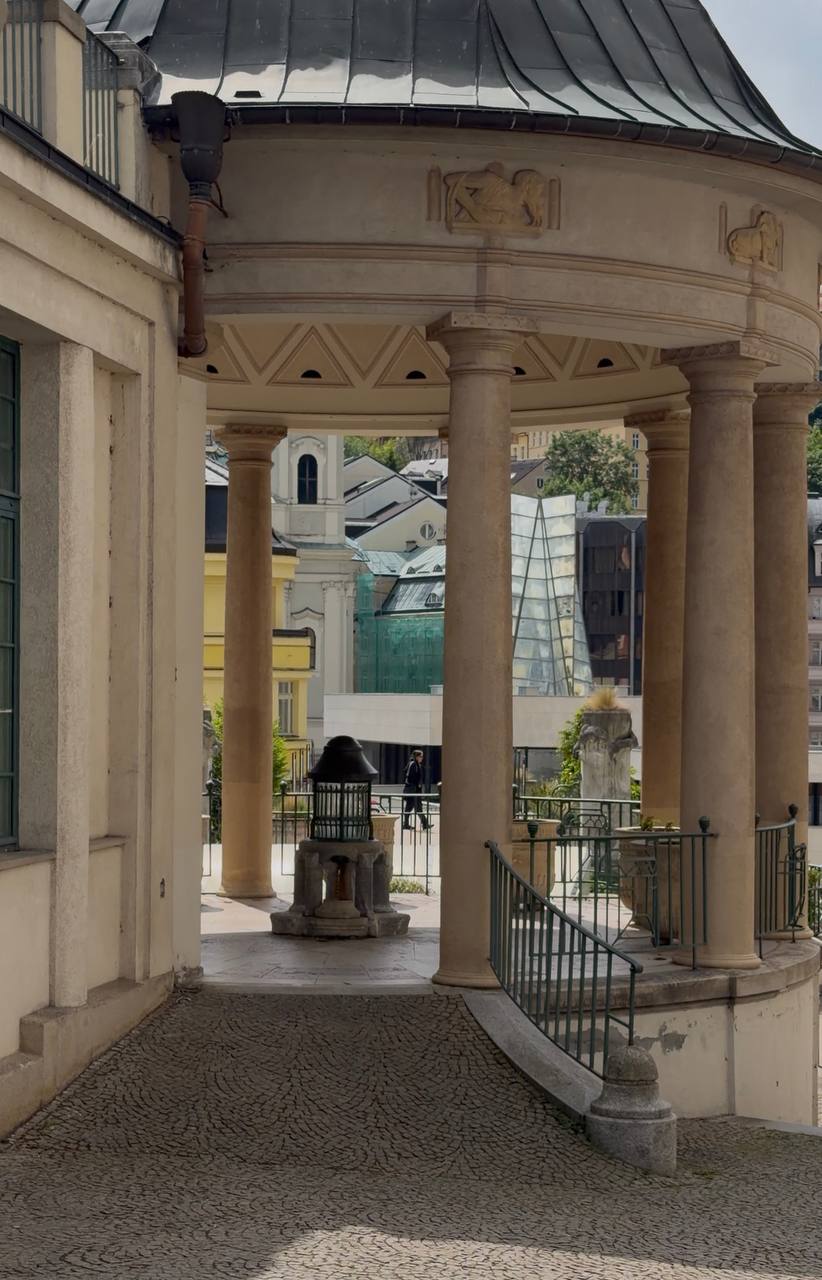
Temperature: 65°C.
Located in the upper part of the Castle Colonnade. Used for digestive conditions, primarily gallbladder and bile duct pathologies. One of the hottest drinkable springs — at this temperature the water has a binding effect.
The main architectural landmark of the spa zone — a 132-metre neo-Renaissance gallery from 1871–1881, designed by architect Josef Zítek. The most beautiful and the most spring-dense colonnade, with five springs. More on the colonnade’s architecture in our guide to Karlovy Vary architecture.
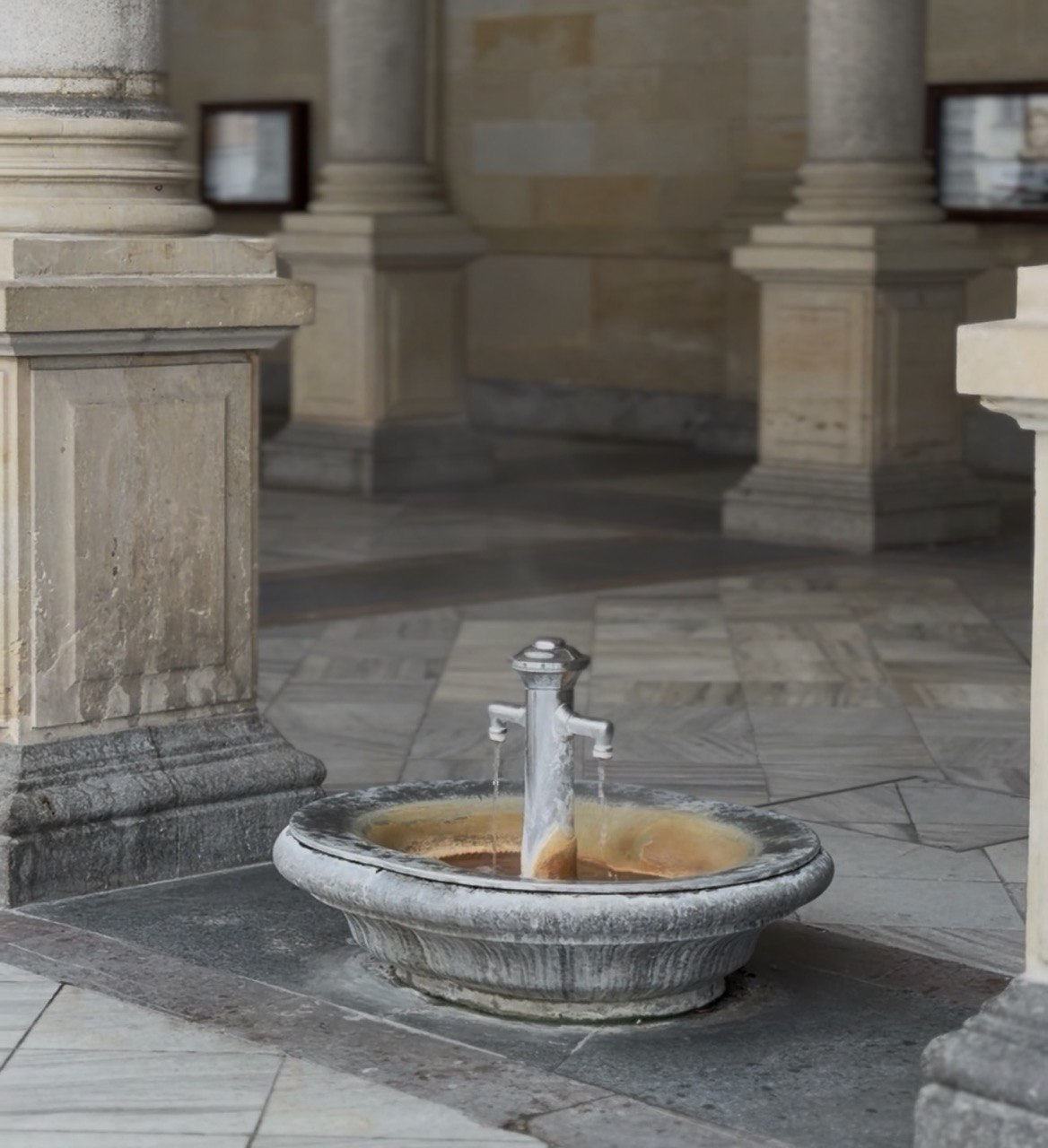
Temperature: 56–58°C.
The spring that gave the colonnade its name. Used for stomach conditions, particularly where gastric secretion is reduced. Mid-range temperature — universal action.
Temperature: 60–62°C.
Named after a figure from Czech folklore. Used for pancreatic conditions and diabetes — one of the springs traditionally prescribed for carbohydrate metabolism disorders.
Temperature: 65.6°C.
Historically, this is the spring from which Karlovy Vary salt was produced for many years. The highly mineralised water leaves a characteristic crystalline deposit when evaporated. Used for digestive and gallbladder conditions.
Temperature: 62°C.
Named after the legendary Czech princess. Used for liver and bile duct conditions.
Temperature: 53–55°C.
Emerges directly from a rock face at the far end of the Mill Colonnade. One of the cooler springs in this colonnade. Used for digestive conditions.
A cast-iron gallery — the only surviving fragment of the demolished Blanenský Pavilion. Located in Dvořák Park, slightly off the main tourist flow.
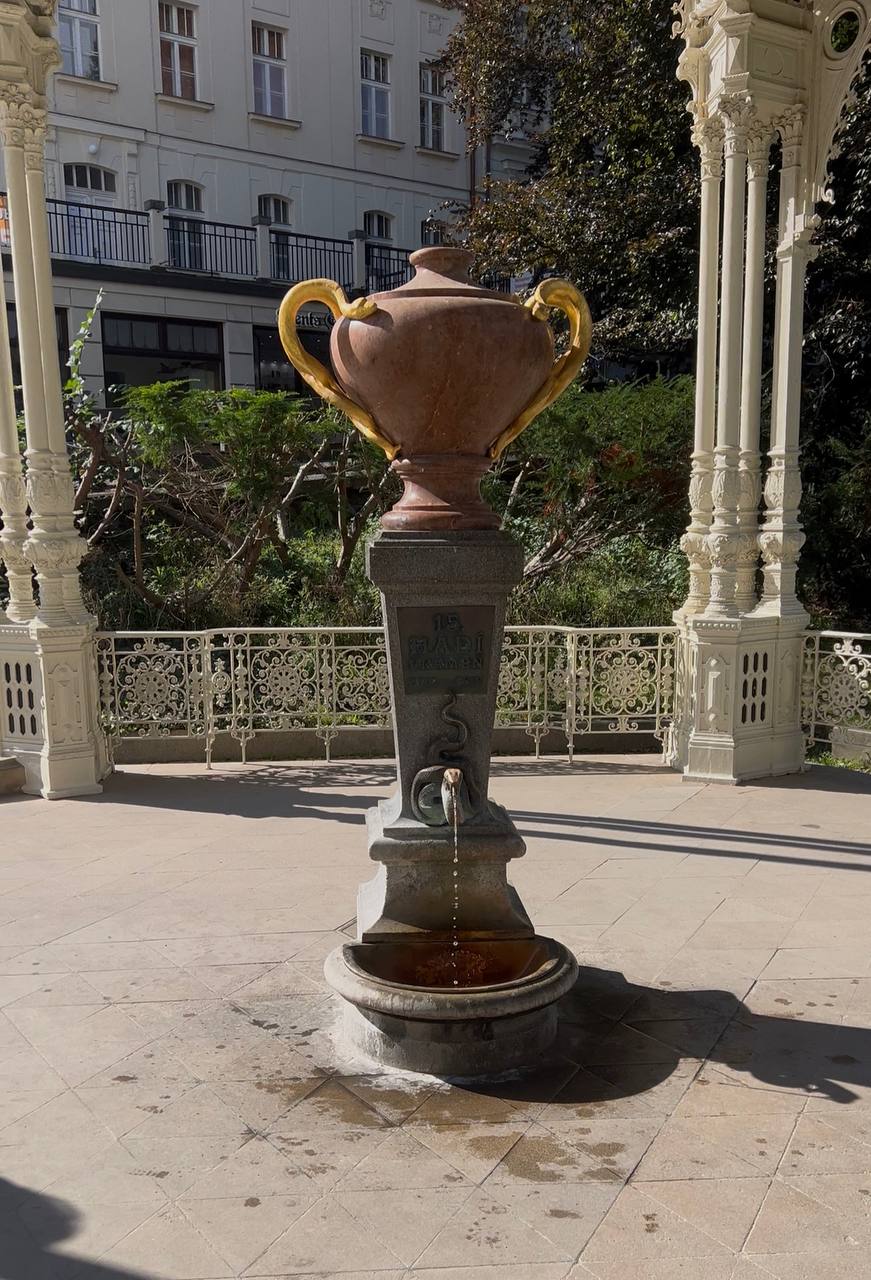
Temperature: 60°C.
The name was assigned after World War II. Traditionally used to stimulate bile secretion and activate pancreatic enzymes. One of the springs prescribed for chronic liver conditions.
Temperature: 30°C.
The coldest spring of all. Contains a record level of carbon dioxide — over 1,200 mg/litre (in hot springs, CO₂ partly escapes; here it stays). Traditionally used for skin improvement — this is the spring from which washing the face is recommended. The highest CO₂ content at low temperature makes it the most “sparkling” in taste of all the springs.
Note: the numbering is non-sequential — historically established, not by location.
Location: separate pavilion near the Park Colonnade.
Temperature: 47.4°C.
One of the most actively prescribed springs for liver conditions, particularly post-hepatitis states and bile production disorders. Temperature below the hot zone gives a gentler choleretic effect without the binding action.
This is arguably the most mysterious of all the springs — and the one that officially bears the number 13.
Temperature: 13°C — the lowest of all.
Distinctive feature: almost no water. Instead, Dorotka emits carbon dioxide at a rate of around 45 litres per minute — one of the most powerful CO₂ sources in the region.
Dorotka has been active since 1884, but disappeared in the 19th century and only reappeared in 1993. The spring is currently closed to the public — the pavilion above it is locked, there is no visitor access. It is used exclusively for scientific monitoring: geologists conduct continuous observation of CO₂ levels in the region. Dorotka is not used for drinking cure treatment.
This is why, when tourists hear about “13 springs of Karlovy Vary,” in practice they encounter 12 accessible drinking springs plus the Vřídlo bowls. Dorotka is part of the official register, but not part of the spa route.
The joke about Becherovka being the “13th spring” emerged precisely because the real 13th spring is physically inaccessible — so Becherovka filled its place in popular memory.
Location: separate pavilion in the Dvořák Park area.
Temperature: 30°C.
Distinctive feature: elevated iron ion content compared to the other springs.
Not officially part of the register of 13, but accessible to visitors. Traditionally used for iron-deficiency anaemia. This is the spring sometimes called the “14th” — but without official status.
This matters more than it might seem — and most tourists get it wrong.
Temperature matters. Hot water (above 60°C) must be drunk in small sips, slowly — otherwise you risk burning the mucosa. This isn’t a metaphor: oesophageal burns from hot water are a real risk.
Most tourists get this wrong — and it’s not just about temperature. There are rules around volume, timing, the order of springs, and what to avoid that make a real difference to both the experience and your safety.
One rule we’ll share here: drink slowly, in small sips. This isn’t ceremony — it’s physiology.
The full set of rules — how much, when, what not to do, and the difference between a tourist visit and a proper drinking cure — is in the complete springs guide.
Water in a bottle won’t travel well — it’s unstable and loses its properties quickly. The classic alternative is Karlovy Vary salt: the evaporated concentrate of the spring water, dissolved at home.
→ Karlovy Vary drinking salt: shop.feelkarlovyvary.cz/collections/drinking-salt
All the springs run along the Teplá river — from the Hot Spring Colonnade to the Park Colonnade, roughly 2 km on foot. You can walk it in either direction: from the Grandhotel Pupp toward the Thermal hotel, or the other way round.
The structure is simple: Hot Spring → Market → Castle → Mill → Park Colonnade. Each colonnade is a self-contained stop with between one and five springs.
A detailed route with timings, a spring-by-spring guide, and an offline map is in the complete springs guide — designed to be used on the spot, without internet access.
Why does the water taste like that? Slightly salty, mildly alkaline, with a faint sulphurous note — this is normal and expected. The high sodium and sulphate content produces exactly this taste. Some find it unpleasant at first — most stop noticing after the third or fourth visit.
Is the water free? The springs themselves — yes, entry is free. You need a drinking cup — available nearby in kiosks (disposable ~30–50 CZK, porcelain souvenir cup from 200 CZK).
Why 13 springs and not 12 or 15? More than 60 mineral springs have been registered in the Karlovy Vary area. Of these, 13 have historically been used for drinking cure therapy and are officially part of the resort infrastructure. The number reflects a historically established system that has been through balneological certification. → Why you shouldn’t drink from just any spring — what doctors say
What is “Becherovka — the 13th spring”? A local joke. Becherovka has been produced in Karlovy Vary since 1807; the recipe includes 20 herbs and Karlovy Vary water. The connection to the springs is only through the water as an ingredient. The real 13th spring — Dorotka — exists but is closed to the public and is not a drinking spring, as described above.
Where can I find a detailed guide to the springs with a map? We put together a dedicated guide — with the parameters of every spring, drinking rules, a walking map, and an offline format designed to be used right at the colonnades. → Karlovy Vary Mineral Springs: Complete Tourist Guide
If you want to see it from another angle — at Cinema Hub on Lázeňská 14, the documentary “Karlovy Vary: The Power of Water” screens daily at 16:00 and 20:00. 60 minutes — geology, history, balneology, and UNESCO. The springs look completely different after watching it.
Karlovy Vary is not decoration around the springs. It’s a place where the springs are the meaning of the city — its history, its medicine, its tourism. To understand this properly, you need to walk the route without rushing, drink consciously, and know what’s actually happening in your cup.
If you want more than an overview — the exact parameters of each spring, the rules of drinking cure practice, a walking map, and tips you can use right at the source — we made a separate guide.
“Karlovy Vary Mineral Springs: Complete Tourist Guide” — offline format, no internet needed, built for visitors who want a conscious walk through the colonnades rather than a random one.
water_drop
Which of the 14 springs is right for you?
This guide shows you which of the 14 springs best suits your needs—and how to avoid common mistakes that can waste half a day.
View guide

📌 Recommended before walking the colonnades
Most tourists drink from the first spring they find and move on — never understanding what it's good for or how to drink it properly.
The guide explains how the springs differ, how to choose the one that's right for you, how to drink correctly, and how to avoid wasting half a day on beginners' mistakes.
Karlovy Vary is a compact city. All the main colonnades fit within a half-hour walk. It sounds…
Karlovy Vary is one of the few resorts in the world where water from natural springs is an official…

Dresden is one of the few cities in Europe that justifies any superlative thrown at it. “Florence…