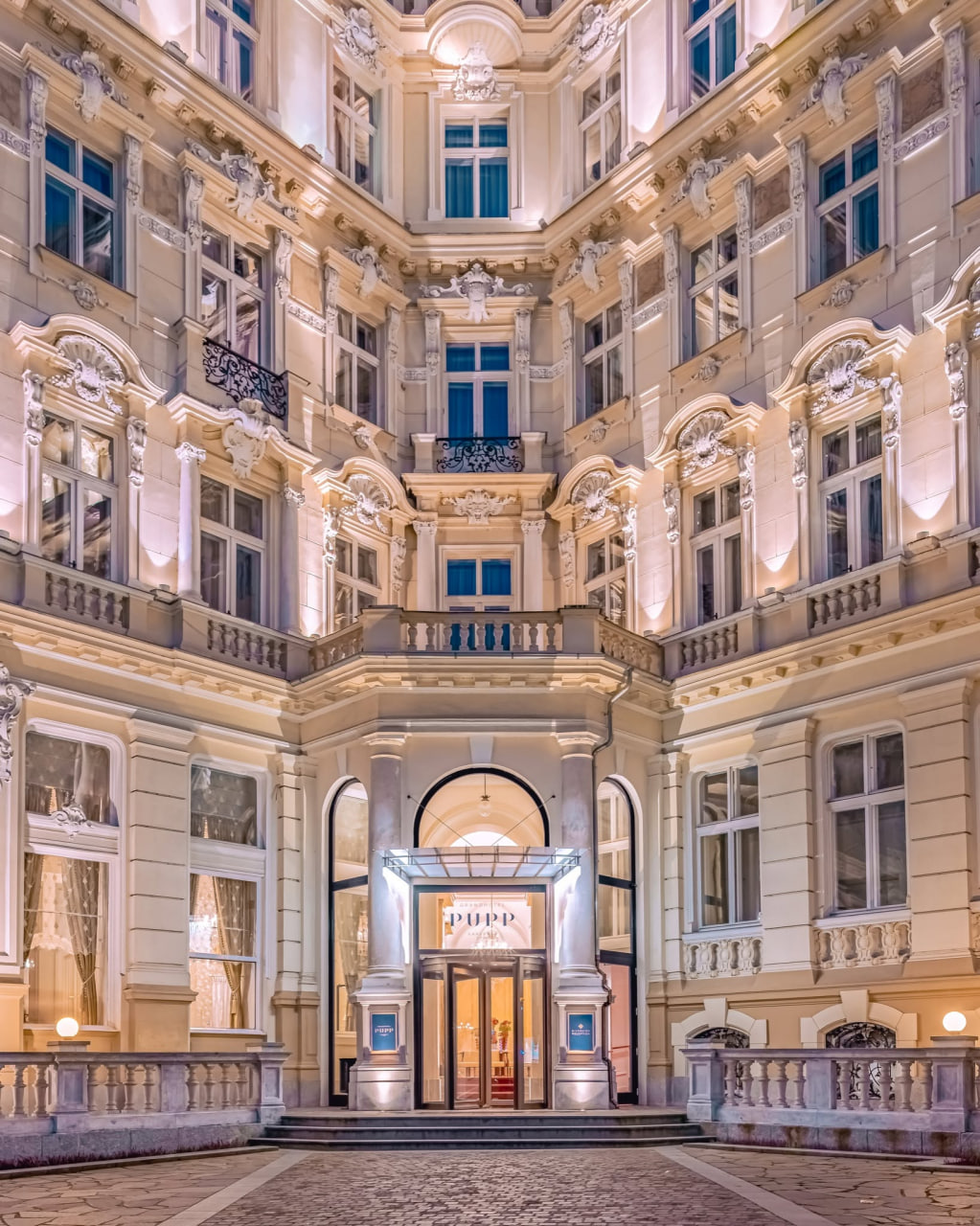
Grandhotel Pupp: History of Karlovy Vary’s Most Famous Hotel Since 1701
Some buildings become the symbol of a city. Grandhotel Pupp is exactly that. A five-star hotel in a…
When it comes to European thermal resorts, Karlovy Vary and Baden-Baden are the two names that come up most often. Both have thousand-year histories. Both have thermal springs, colonnades, famous guests, and UNESCO status. Both belong to the Great Spa Towns of Europe association.
And yet — these are fundamentally different places with different medical specialisations, different atmospheres, different cultures of stay, and different prices. Comparing them as “better or worse” is as misplaced as comparing a gastroenterologist to a rheumatologist. The right question is: “What do I need, and where am I going?”
I live in Karlovy Vary and know Baden-Baden well as a competing resort. Here’s an honest breakdown — without promoting one at the expense of the other.
This determines everything else.
Karlovy Vary — sodium-bicarbonate-sulphate waters. Key components: sodium bicarbonate, sodium sulphate (Glauber’s salt), sodium chloride, high CO₂ content. Therapeutic profile: the digestive system — stomach, intestines, liver, gallbladder, pancreas. Plus metabolic disorders — diabetes, gout, obesity. 13 thermal springs with temperatures ranging from 28–72°C, combined flow rate around 2,000 litres per minute.
water_drop
Which of the 14 springs is right for you?
This guide shows you which of the 14 springs best suits your needs—and how to avoid common mistakes that can waste half a day.
View guide
Baden-Baden — sodium-chloride thermal waters. A completely different chemical type: high chloride and sodium content, which makes the water closer to sea water than to drinking medicinal water. The different composition comes from the rocks the water passes through: in Baden-Baden these are sedimentary formations producing a chloride-sodium profile; in Karlovy Vary — post-volcanic granite formations producing the bicarbonate-sulphate profile. Therapeutic profile: musculoskeletal system, joint and rheumatic conditions, cardiovascular system, nervous system, respiratory conditions. 12 springs, temperatures 56–68.8°C, flow rate 800,000 litres per day.
Practical takeaway: gastritis, peptic ulcer, liver problems, diabetes, metabolic disorders — Karlovy Vary. Rheumatism, arthrosis, joint pain, post-injury rehabilitation, cardiovascular system — Baden-Baden. Fundamentally different indications, not “the same resort in a different country.”

This is another fundamental difference.
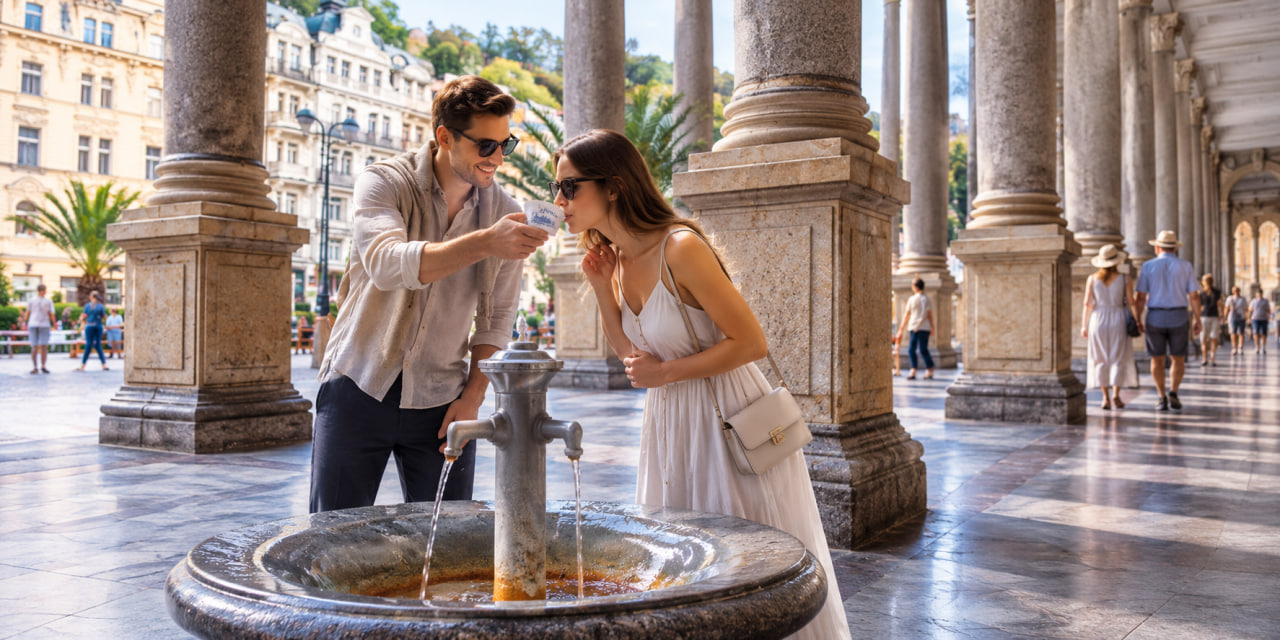
In Karlovy Vary, the core treatment method is drinking therapy. Water is drunk from specific springs on a physician’s prescription: a specific spring, a specific volume, a specific time before meals. Walking between colonnades is part of the protocol. The promenade galleries (colonnades) exist precisely for this: to drink water while moving, in small sips, in motion. The entire urban infrastructure — colonnades, drinking cups, routes between springs — is built around drinking cure practice.
In Baden-Baden, the primary method is balneotherapy — therapeutic baths. Immersion in thermal water. Two main bathing establishments define the resort’s experience: Friedrichsbad — historic baths in the Roman tradition, 17 stages of treatments including a soap-brush massage, textile-free bathing (except on designated days), built 1869–1877. Caracalla Therme — a modern thermal complex with pools at different temperatures, jacuzzis, saunas, suitable for families with children.
There is a drinking fountain in Baden-Baden too — the Trinkhalle, a beautiful historic building from 1839–1842 with a long colonnade. But drinking therapy here is a supplement, not the foundation. The main event is the baths.
This is perhaps the most palpable difference.
Karlovy Vary is a living spa city of 47,000 people. Tourist, multilingual, active. The springs are in the very centre of the city, along the river, accessible to everyone. In July — the Karlovy Vary International Film Festival (KVIFF), Category A like Cannes. There are budget guesthouses and five-star hotels, waffle stalls and serious restaurants. The city is heterogeneous — and that’s part of its character.
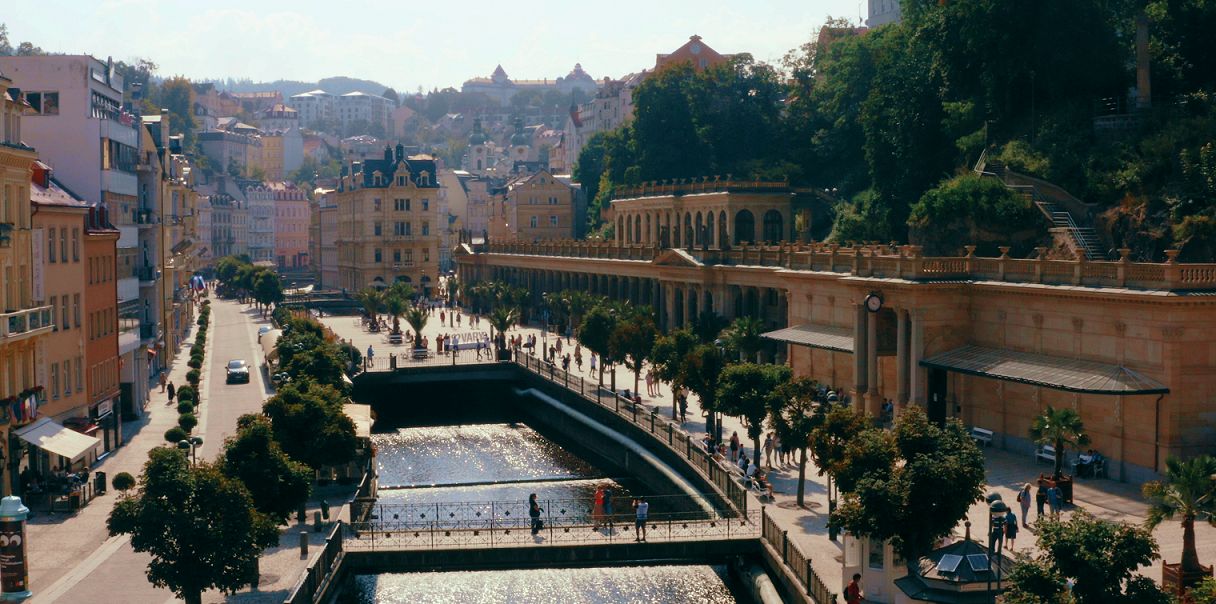
Baden-Baden is an elegant small town at the foot of the Black Forest in south-west Germany. People walk slowly, talk quietly, seniors read newspapers on park benches. This consciously cultivated stillness and refinement is part of the city’s brand. Population around 55,000, but in feel it is a far more intimate place than Karlovy Vary. Aristocratic elegance is not decoration — it’s a principle of the city’s existence. Casino, opera, horse racing — a constant cultural programme. The clientele matches.
If Karlovy Vary is a lively resort open to all categories of guest, Baden-Baden is a quiet, expensive, consciously refined destination.
Karlovy Vary — legendarily founded by Charles IV in 1358. Goethe (13 visits), Peter the Great, Bach, Beethoven, Schiller, Paganini, Gogol, Turgenev, Kafka, Marx — the list of famous guests goes on. The resort was always accessible to a broad educated public, not only aristocracy.
Baden-Baden — the Romans arrived here in the 1st century AD and built baths under Emperor Caracalla (hence the name of the modern complex). In the 19th century — the summer capital of European aristocracy. Napoleon III, Queen Victoria, Dostoyevsky (who lost everything at the casino there), Turgenev (who lived there for several years), Brahms, Liszt. The casino opened in 1824 — the oldest in Germany. Baden-Baden was “the summer capital of Europe” — a title the city clearly still remembers.
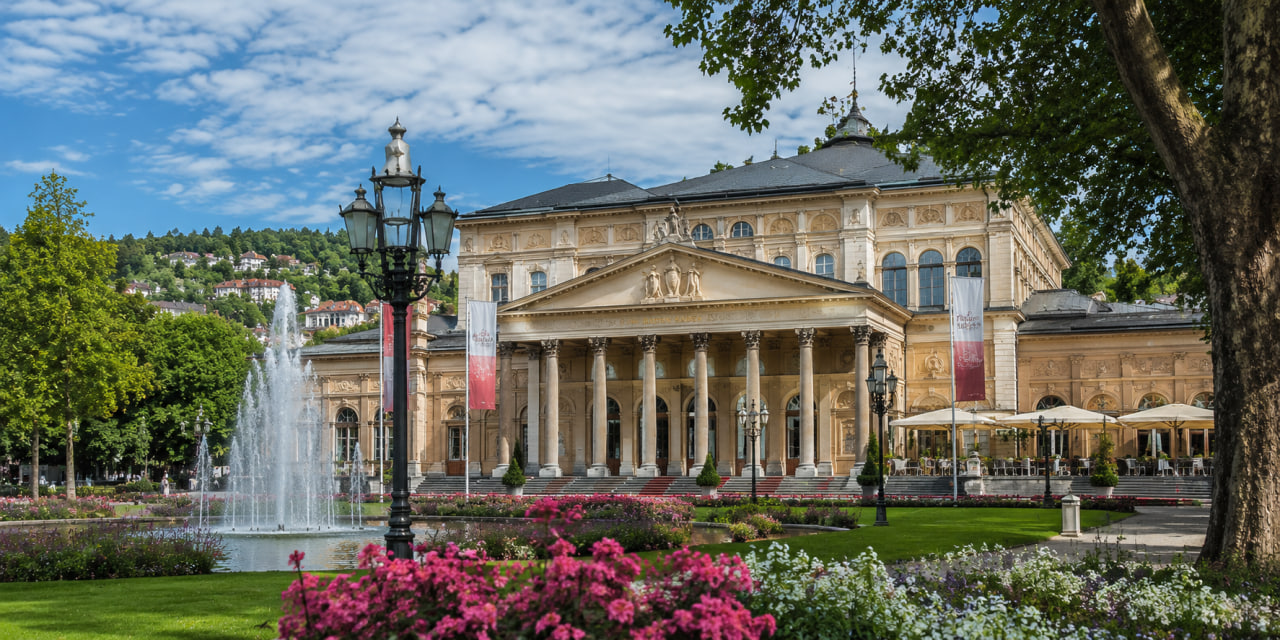
Both cities entered the UNESCO World Heritage List in 2021 as part of the “Great Spa Towns of Europe,” alongside Vichy, Spa, Montecatini Terme, Bath, and others.
Baden-Baden is significantly more expensive.
Entry to Friedrichsbad: from €35 (basic) to €65 (with soap-brush massage). Caracalla Therme: from €18 for 2 hours. Hotels: a good central hotel starts at €180–250 per night; luxury (Brenners Park Hotel) — from €500 upwards. Baden-Baden positions itself as a premium resort, and prices reflect that.
Karlovy Vary is more accessible. Entry to the springs — free (only the drinking cup costs ~50–100 CZK). Sanatoriums: from €60–80 per day in the budget segment, from €150 in the mid-range, Savoy Westend or Grandhotel Pupp — from €200 upwards. Karlovy Vary covers the full budget range; Baden-Baden primarily the upper end.
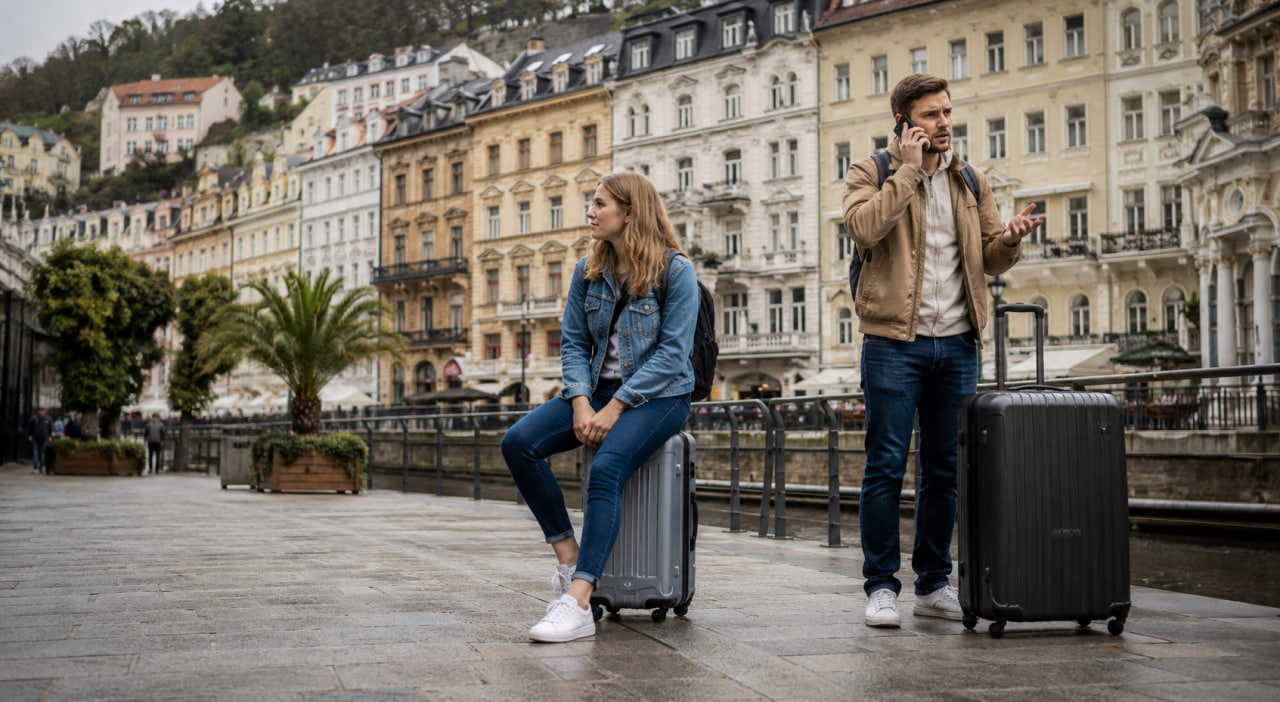
Karlovy Vary — 1.5 hours from Prague by bus, direct flights from many cities. A relatively accessible destination for guests from Central and Eastern Europe, the CIS.
Baden-Baden — located in south-west Germany, 30 km from Strasbourg (France). Nearest airport: Karlsruhe/Baden-Baden or Strasbourg. Convenient for guests from Western Europe and those flying via Frankfurt.
Distance between Karlovy Vary and Baden-Baden — around 700 km. This is not “a tour of two resorts in one weekend” — it’s a choice between two different trips.

Choose Karlovy Vary if:
Choose Baden-Baden if:
Despite all the differences, several things connect Karlovy Vary and Baden-Baden:
This intangible quality — ritual, deceleration, intentionality — is what visitors seek in both places. And what’s difficult to replicate in an ordinary spa hotel.
If your choice is Karlovy Vary, a few practical orientations:
Start with the springs — walk all five colonnades, try the water at different temperatures, understand the differences. A detailed guide to all 13 springs: All 13 Springs of Karlovy Vary.
If you’re coming for treatment — understand the formats. There’s a sanatorium course with a physician and therapeutic diet, and an outpatient format where you stay in a hotel and visit the springs independently. Full breakdown: Drinking Cure in Karlovy Vary.
At City Hub “Feel Karlovy Vaey”, daily at 16:00 and 20:00 — the documentary “Karlovy Vary: The Power of Water.” 60 minutes on the geology of the springs, the history of the resort, balneology. A good introduction to the city, especially for a first visit.
Karlovy Vary salt — the concentrate of the spring water — lets you continue the drinking ritual at home: shop.feelkarlovyvary.cz.

Can you visit both resorts in one trip? Logistically yes, but not in one weekend. The distance is 700 km. A realistic option: separate trips for different purposes. Or a Germany/Czech Republic route with a 3–5 day stop at each.
Which resort is older? By springs — equally ancient; both were used in antiquity. Karlovy Vary received its spa town status in the 14th century; Baden-Baden developed actively from the 19th century as an aristocratic destination.
Are both UNESCO listed? Yes. Both were inscribed on the UNESCO World Heritage List in 2021 as part of the “Great Spa Towns of Europe.”
Which resort has better beer? In Karlovy Vary — Pilsner Urquell and local Czech brands. This isn’t just a tourist cliché: the Czech Republic objectively leads in world brewing. Baden-Baden also has its own brewery, but that’s an entirely different, German context.

📌 Recommended before walking the colonnades
Most tourists drink from the first spring they find and move on — never understanding what it's good for or how to drink it properly.
The guide explains how the springs differ, how to choose the one that's right for you, how to drink correctly, and how to avoid wasting half a day on beginners' mistakes.
Some buildings become the symbol of a city. Grandhotel Pupp is exactly that. A five-star hotel in a…
Karlsbad ist eine kompakte Stadt. Alle wichtigen Kolonnaden passen in einen halbstündigen…
Karlovy Vary is one of the few resorts in the world where water from natural springs is an official…