Homepage / Blog / Grandhotel Pupp: History of Karlovy Vary’s Most Famous Hotel Since 1701
Grandhotel Pupp: History of Karlovy Vary’s Most Famous Hotel Since 1701
event_note
17.09.2026
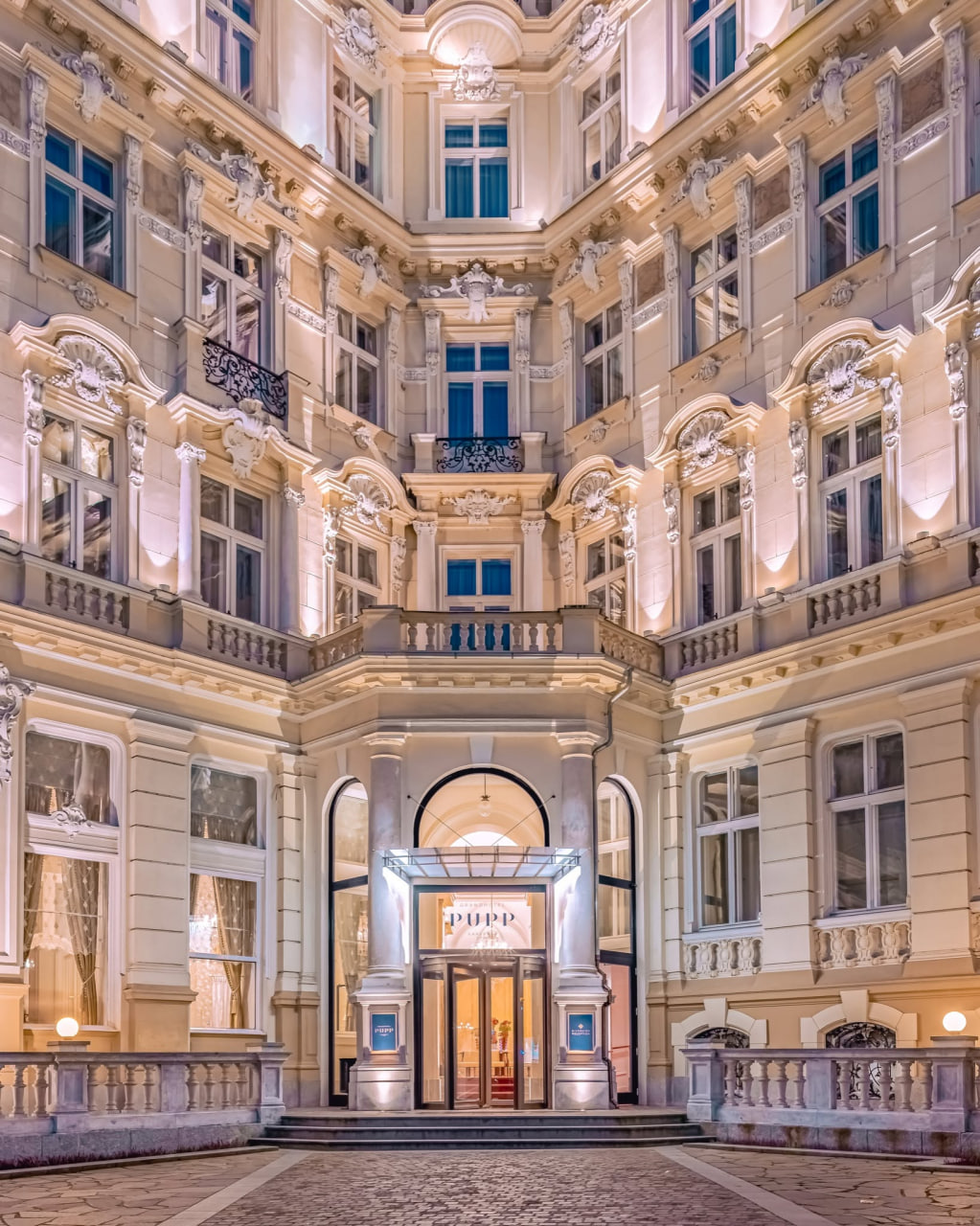
Some buildings become the symbol of a city. Grandhotel Pupp is exactly that. A five-star hotel in a Neo-Baroque palace on the banks of the Teplá River, at the end of the main spa promenade. Everyone who comes to Karlovy Vary photographs it — even those who don’t stay there.
Behind that facade lies more than 300 years of history. A confectioner who founded a hotel dynasty. Tsars, emperors, composers, and writers sharing the same corridors. Nationalisation, renaming, the return of an identity. And James Bond.
1701: The Saxon Hall — Where It All Began
The history of Grandhotel Pupp begins not with a hotel, but with a ballroom.
In 1701, the mayor of Karlovy Vary, Anton Deiml, commissioned the construction of a grand hall on the banks of the Teplá for the aristocratic guests of the resort — the so-called Saxon Hall (Sächsischer Saal). The Saxon Elector Friedrich August provided financial support, and seasonal staff arrived from Leipzig to serve the guests — hence the name.
Soon, on the other side of the river’s bend, another mayor — Andreas Becher — built his own hall: the Bohemian Hall. Two halls, perpendicular to each other, together with the later-built House “At God’s Eye,” formed the foundation of what would become the hotel.
Johann Georg Pupp: The Confectioner Who Built a Dynasty
In 1760, a young confectioner arrived in Karlovy Vary from Belarus — Jan Jiří Pop. He found work with a local confectioner named Mitterbach.
In 1775, he married Mitterbach’s daughter Františka. The widow of former mayor Becher had by then sold a one-third share of the Bohemian Hall to Františka. In 1776, the couple bought the remaining shares and became sole owners. It was at this point that Jan Jiří Pop began using the German variant of his name — Johann Georg Pupp.
This was a story of classic entrepreneurial triumph: a confectioner in the aristocratic society of the Austro-Hungarian Empire, building step by step what would become, within a few generations, one of the most famous hotels in Europe.
Throughout the 19th century the business grew steadily. In 1890, the Pupp family acquired the Saxon Hall — now both buildings belonged to one owner. That same year, a joint-stock company was formed.
1896–1907: Fellner & Helmer — The Birth of a Palace
In 1896, the Pupp brothers — Anthony, Julius, and Heinrich — entrusted the reconstruction of the entire complex to the Viennese architectural firm Fellner & Helmer — the most celebrated theatre and hotel architects in Central Europe at the time.
These same architects designed the Karlovy Vary Mill Colonnade (1871–1881), the Park Colonnade, and dozens of theatres across the Austro-Hungarian Empire.
The reconstruction continued until 1907. The result: a unified Neo-Baroque palace complex with richly decorated facades, state rooms, a mirror hall, and the Grand Restaurant. This is the building that stands today.
The official opening of the current building was in 1894. By 1907, all sections had been incorporated into a single unified complex.
Guests Who Wrote the Hotel Into History
The guest list of Grandhotel Pupp reads like a textbook of European culture and politics.
Monarchs and statesmen: Peter the Great (the Russian Tsar visited Karlovy Vary several times), Franz Joseph I (Emperor of Austria), Edward VII (King of Great Britain).
Composers: Johann Sebastian Bach, Ludwig van Beethoven, Richard Wagner — all stayed in Karlovy Vary at different times and frequented the halls on the Teplá.
Writers and thinkers: Johann Wolfgang von Goethe (13 visits to Karlovy Vary), Franz Kafka, Sigmund Freud.
Contemporary guests: Morgan Freeman, Jude Law, Johnny Depp — many of them attending the Karlovy Vary International Film Festival.
Nationalisation and Renaming: A Dark Chapter
After the end of World War II in 1945, the hotel was nationalised. The Pupp family emigrated.
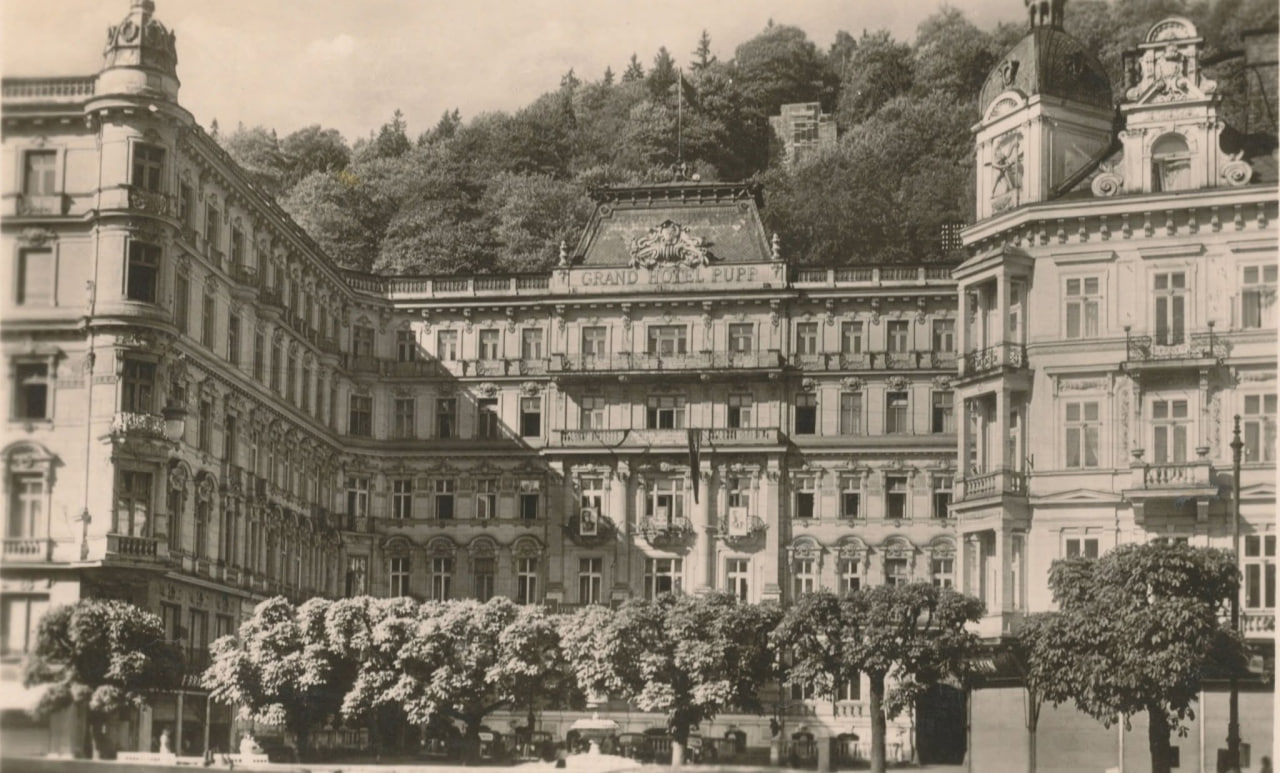
During the communist era, the hotel was renamed — it became “Moscow” (Moskva). The Pupp name disappeared from the facade for decades.
After the Velvet Revolution of 1989, the historic name was restored. Grandhotel Pupp became Grandhotel Pupp once again.
Casino Royale 2006: How Pupp Became Hotel Splendide
In 2006, the film Casino Royale was released, starring Daniel Craig as James Bond. A significant portion of the filming took place in Karlovy Vary — and Grandhotel Pupp played the role of the fictional Hotel Splendide in Montenegro, where the central card tournament takes place.
Visible in the film: the main facade of the hotel, the grand staircase, the casino interiors (dressed within the building), and the Teplá promenade in front of the entrance.
This was not the hotel’s first screen appearance. Last Holiday with Queen Latifah and Gérard Depardieu was also filmed here.
For tourists who arrive in Karlovy Vary after watching Casino Royale — Grandhotel Pupp looks exactly as it did in the film. The facade is unchanged.
KVIFF: Hotel and Film Festival
The Karlovy Vary International Film Festival (KVIFF) is the only Category A film festival in Central Europe. Grandhotel Pupp has been its main venue since the festival’s founding.
Every July, the red carpet at the hotel’s main entrance becomes the centre of the region’s cinematic life. Official receptions, press conferences, and meetings take place here. Many of the festival’s star guests stay at the hotel itself.
Architecture: What to See Outside and Inside
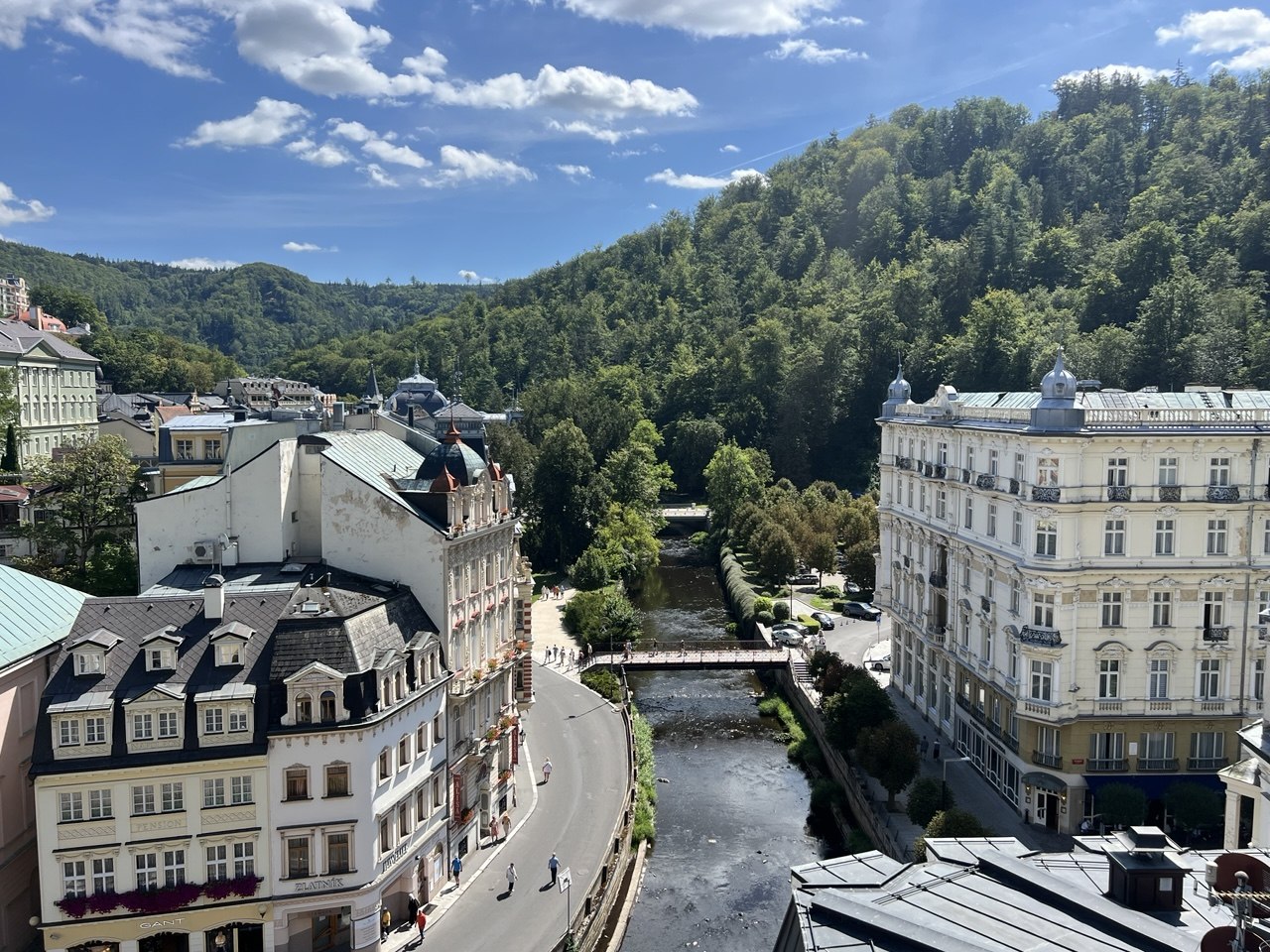
Outside: Neo-Baroque facade with rich stucco decoration, risalites, a dome over the central section. The building occupies an entire city block on the bend of the Teplá — best viewed from the opposite bank or from the bridge in front of the entrance.
Inside (accessible to non-guests too):
Café Pupp — a café in a historic interior, open to everyone. A good place for coffee and pastries with a view of the promenade.
Grand Restaurant — a state room with historic decor. Lunch or dinner here is an experience in itself.
Becher’s Bar — named after the founder of Becherovka (Becher was a mayor whose hall became part of the complex).
Mirror Hall — the historic event space.
Spa Franziska — named after the founder’s wife, Františka Pupp. During the construction of the spa area, glass bottles with historic documents were discovered, including a recipe for a relaxing bath written by Františka herself. The recipe is used in the hotel spa today.
Practical Information: How to Visit and What It Costs
Address: Mírové náměstí 2, Karlovy Vary — at the end of the main spa promenade, ~500 metres from Vřídlo on foot along Nová Louka.
Café Pupp: open to everyone, coffee and desserts from €4–8. The most accessible way to experience the interior.
Grand Restaurant: dinner from €50–80 per person. Dress code: smart casual.
Accommodation: from ~€180–250 for a standard room in low season, up to €400 and above in high season. 228 rooms and suites.
Terrain cure: the main terrain cure route to Diana Tower begins at the hotel’s main entrance — 30–40 minutes of ascent through the forest.
Details You Won’t Find in a Guidebook
Františka’s bath recipe. During construction of the spa area, workers discovered sealed bottles containing 18th-century documents. Among them: a handwritten bath recipe by Františka Pupp. The recipe is used in the hotel’s spa today.
The Becherovka connection. The Bohemian Hall — the predecessor of part of Grandhotel Pupp — was built by Mayor Andreas Becher, a relative of the Becher who gave his name to the liqueur. Karlovy Vary’s history is closely interwoven.
Six generations. Before the 1945 nationalisation, six generations of the Pupp family managed the hotel — from 1775 to 1945. That is 170 years of one family.
Ongoing restoration. The hotel is currently undergoing a major, sensitive restoration of its historic interiors — preserving original 19th and early 20th-century details throughout.
Grandhotel Pupp and City Hub Feel Karlovy Vary
Diana Tower — the main viewpoint of Karlovy Vary — sits directly above Grandhotel Pupp. The terrain cure route begins at the hotel’s main entrance.
If you want to understand the history of Karlovy Vary in context — start your day with the documentary “Karlovy Vary: The Power of Water” at City Hub on Lázeňská 14 (screenings at 16:00 and 20:00), then walk along the promenade to Pupp. The history of the resort and the history of the hotel become a single narrative.
Discover the secrets of Karlovy Vary in the film “The Power of Water”
A unique documentary film about thermal springs, the history of the resort, healing water and why Karlovy Vary became one of the most famous spa towns in Europe.
alarm60 minutes in Russian, English, German and Czech
calendar_monthScreenings daily at 16:00 and 20:00
location_onCinema hall in the center, next to the Mill Colonnade