Karlovy Vary for Type 2 Diabetes: What the Drinking Cure Does
Karlovy Vary began treating diabetes before insulin was discovered. In 1815, physician Hufeland…
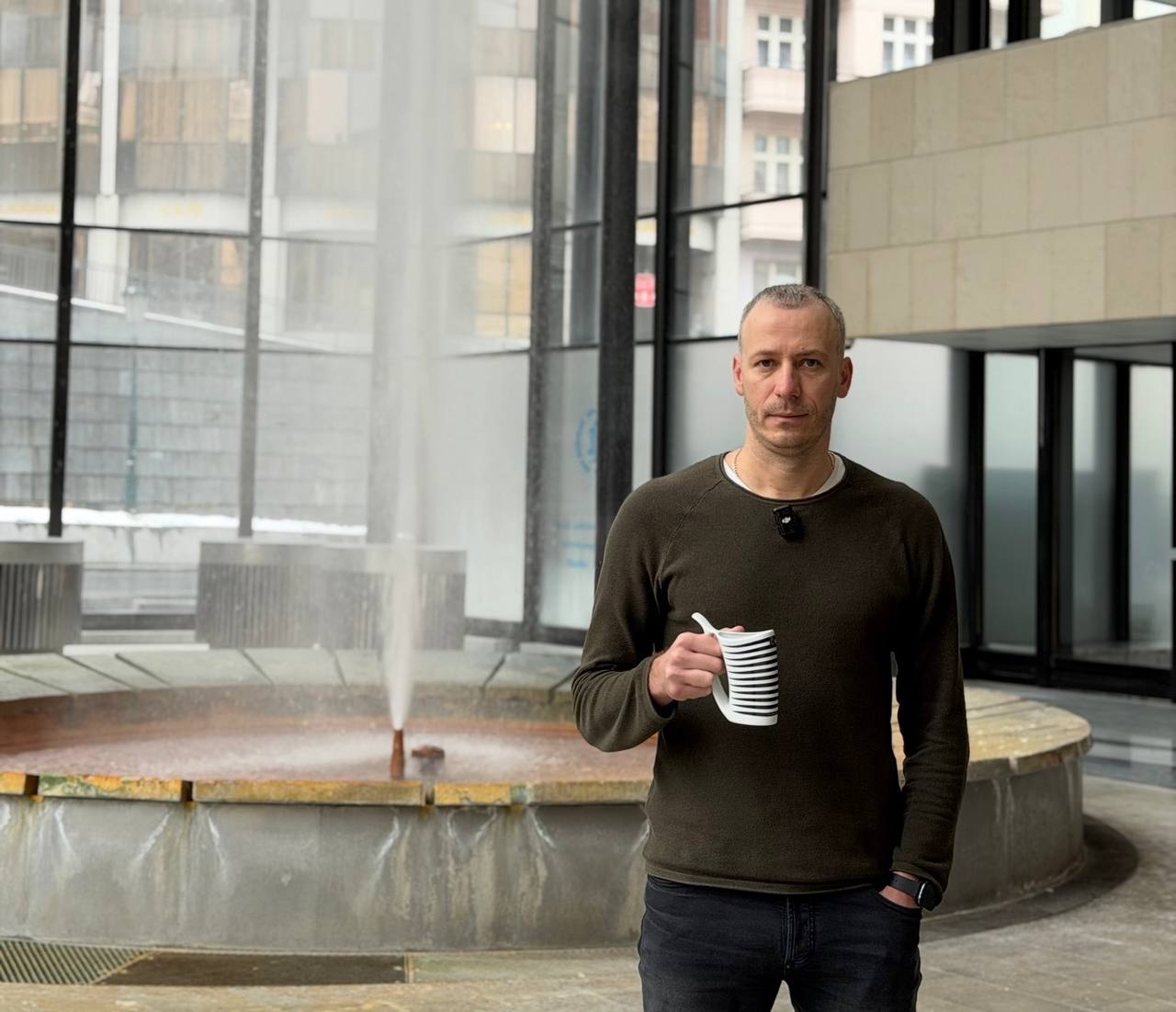
Vřídlo is the first thing every visitor to Karlovy Vary sees. A jet of hot water nearly 12 metres high, steam above the colonnade, a sound you can hear from outside. Most people photograph it, admire it — and move on. But behind this spectacle lies a geological story millions of years in the making and a medical logic that explains why this particular spring became the heart of the resort.
Here’s everything in order: how the geyser works, why the water is so hot, what happens to the minerals on the way to the surface, and why Vřídlo is not simply a beautiful fountain.
Vřídlo is the only true geyser among all 13 springs of Karlovy Vary. The others emerge calmly. Vřídlo erupts under pressure — and that is a fundamental difference.
Temperature at source: 72–73°C. The hottest drinking water in Europe from a natural spring.
Jet height: up to 12 metres. For scale — that’s the height of a four-storey building.
Flow rate: approximately 2,000 litres per minute. Over 24 hours, Vřídlo brings roughly 18–19 tonnes of dissolved mineral salts to the surface. An amount that’s difficult to picture — comparable to the daily output of several large production facilities.
Depth: the water rises from approximately 2–2.5 kilometres below ground.
Karlovy Vary sits in a zone of ancient post-volcanic activity. The granite rocks of the Bohemian Massif retain residual heat from magmatic processes that ended millions of years ago — but have not fully ceased.
Atmospheric precipitation filters into cracks in the granite, slowly descends to a depth of 2–2.5 km, heats to 73°C from the residual geothermal heat of the rock, and simultaneously becomes saturated with minerals: sodium, calcium, magnesium, potassium, bicarbonates, sulphates, chlorides, carbon dioxide, and more than 40 other elements.
The ascent happens through dissolved CO₂ — a process called gas lift. The carbon dioxide makes the water-gas mixture less dense than the surrounding rock and literally pushes it upward through the fissures. It’s the pressure of the CO₂ that creates the geyser effect — the water isn’t simply flowing, it’s being expelled.
Scientists estimate the age of the water in Karlovy Vary’s springs at approximately 35,000 years. The water you drink at the colonnade began its underground journey in the Pleistocene epoch, when mammoths roamed this landscape.
All 13 springs of Karlovy Vary belong to a single hydrogeological body and have essentially identical chemical composition. What distinguishes them is temperature and CO₂ content.
Vřídlo stands apart on several parameters:
The hottest. 72–73°C — 10–20 degrees hotter than most other springs. This isn’t merely a temperature record; it’s a fundamentally different therapeutic effect.
The most powerful. 2,000 l/min — several times the flow of any other spring. This is why Vřídlo supplies the entire resort: water is piped to sanatoriums throughout the spa zone for mineral baths.
The only geyser. The CO₂ pressure that throws water 12 metres into the air is unique in Central Europe.
The highest mineralisation. Due to its high temperature and powerful flow, Vřídlo carries more dissolved salts than any other spring — historically, Karlovy Vary salt was produced from its water.
There’s one thing most tourists don’t notice — or don’t understand — but it vividly illustrates what happens to Vřídlo’s water.
Look at the pipes, walls, and fittings inside the colonnade. Everything is coated with a pale brown or whitish deposit — this is Carlsbad stone, or aragonite. It forms when hot mineral water contacts air: CO₂ escapes, minerals precipitate, and crystallise.
The same process occurs on teeth and mucosa when drinking the water — which is exactly why regular drinking cure practice uses a spa cup with a spout: the spout directs water to the back of the mouth, reducing direct contact between minerals and tooth enamel.
Carlsbad stone isn’t a problem — it’s proof. The visible mineral deposits on surfaces demonstrate convincingly that the water actually contains what’s written on a Karlovy Vary salt label.
In the underground museum beneath the colonnade, you can see the crystallisation of Carlsbad stone — one of the most vivid exhibits that explains the chemistry of the springs better than any lecture.
Drinking water at 72°C is impossible — it would burn the oesophagus. So inside the colonnade, the water is cooled and delivered through several outlets at different temperatures.
They are officially marked A, B and C:
Bowl C — approximately 30°C (the coolest). At low temperature, the water retains maximum dissolved CO₂. Effect: enhanced stimulation of intestinal motility, choleretic action, mild laxative effect. Traditionally prescribed for constipation and bile secretion disorders.
Bowl B — approximately 41–50°C (medium). The universal temperature for most indications. This is the bowl recommended for first-time drinkers of Vřídlo water.
Bowl A — approximately 57°C (the hottest of the drinkable outlets). At higher temperature, CO₂ partly escapes; the water acts in a binding, calming way. Traditionally prescribed for high stomach acidity and diarrhoea.
A spa physician’s prescription of a specific bowl is not a formality. It is a concrete medical instruction based on your diagnosis and stomach acidity. “Drink from bowl B” and “drink from bowl A” for gastritis are different protocols with different effects.

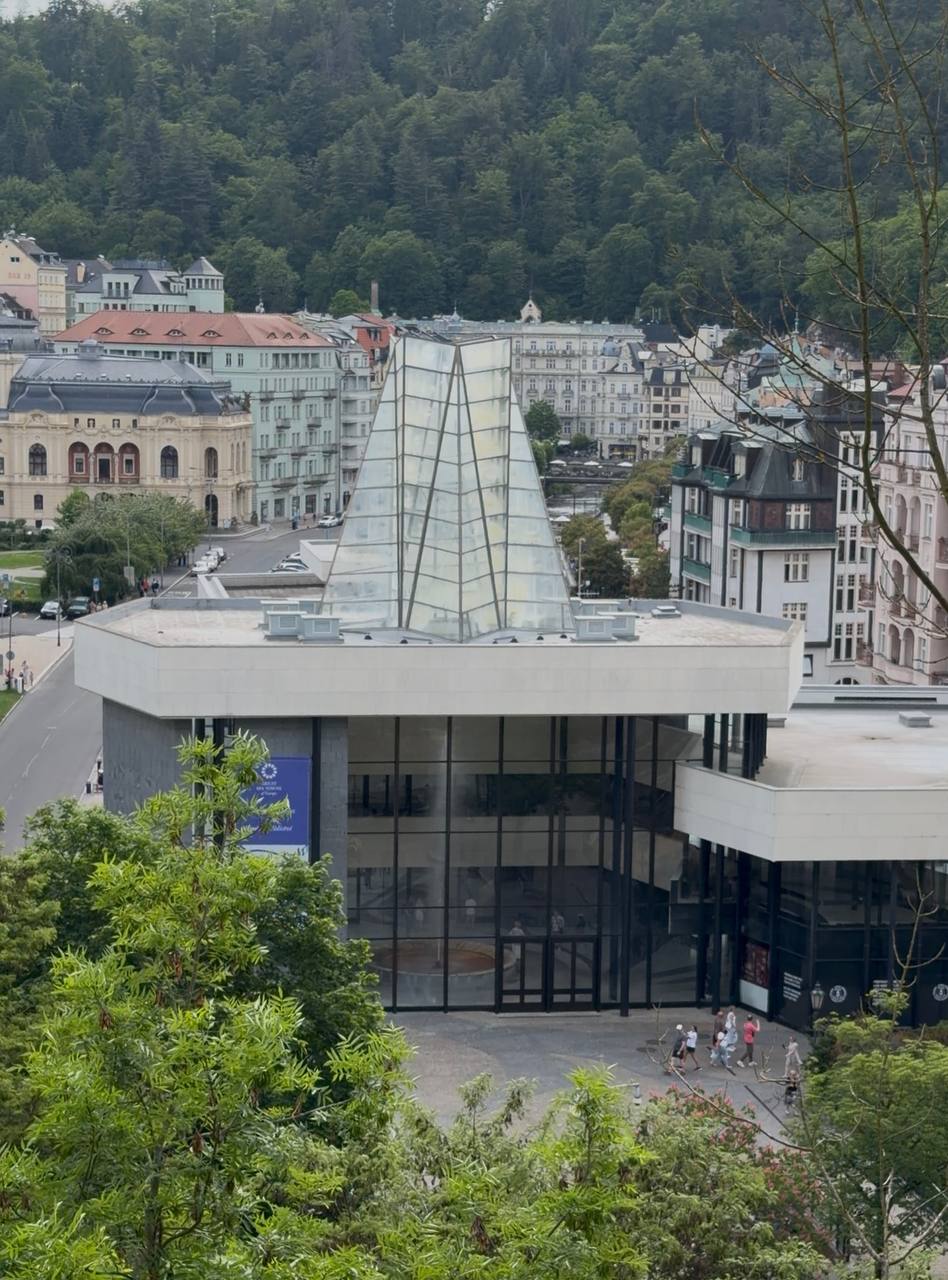
The current Hot Spring Colonnade — the glass-and-concrete functionalism of 1975 — is the third structure on this site.
The first colonnade was built in 1826 in Empire style. An elegant simple building that stood for half a century.
The second colonnade — cast iron, 1878–1879, designed by Viennese architects Fellner and Helmer (the same pair who built the Municipal Theatre and Goethe’s Lookout). A lavish Victorian-style building that stood for nearly 60 years. In 1939, the corroded structure was dismantled.
A temporary wooden structure served for 35 years — from 1939 to 1975.
The current building opened on 11 May 1975. Architect: Jaroslav Otruba. A functionalist glass box that was modern and controversial when it opened. Today it has itself become part of the resort’s history.
Inside the building, the geyser occupies a separate glazed pavilion — a solution that didn’t exist from the beginning; previously the water simply flowed through open bowls and steam filled the entire space.
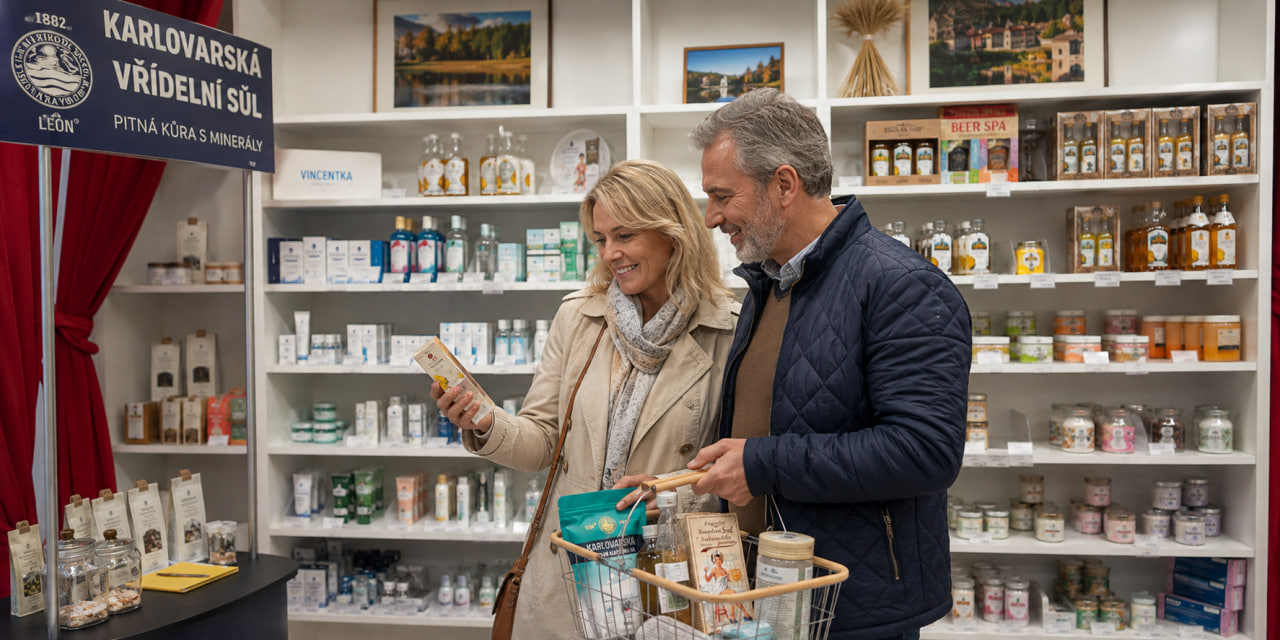
The Karlovy Vary salt sold in pharmacies and taken home is evaporated Vřídlo water. Historically, salt was produced by evaporating water from this spring: water was heated, the water evaporated, and the minerals remained.
The technology today is more refined, but the principle is the same: spring water is taken, evaporated, and the crystalline residue is Karlovy Vary salt. The salt’s composition is identical to the water’s — sodium bicarbonate, sodium sulphate, sodium chloride, potassium sulphate, and over 40 trace elements.
When you dissolve a teaspoon of Karlovy Vary salt in a glass of warm water and drink it on an empty stomach each morning, you are effectively drinking Vřídlo water — in concentrated, reconstituted form. A home method for continuing what happens at the colonnade.
Vřídlo is the most famous — but far from the only interesting spring in the resort. Each of the 13 springs has its own temperature, its own CO₂ profile, its own history, and its own traditional balneological application.
If you want to understand the spring system in depth — which spring for which condition, how to build a conscious colonnade route, what each temperature means for digestion — all of this is collected in our detailed guide to the Karlovy Vary springs.
→ Complete guide to the Karlovy Vary springs
Can you drink water directly from the geyser? No — 72°C would cause a serious oesophageal burn. The cooling bowls (A, B, C) inside the colonnade bring the temperature to 30–57°C and are designed for drinking.
Why is the geyser sometimes not erupting? Vřídlo runs continuously, but jet strength can vary with CO₂ pressure in the system. Planned technical maintenance and cleaning of Carlsbad stone deposits are performed regularly — during these periods the geyser may be stopped.
Is the water in the bowls the same as in the geyser? Yes. The same water, simply cooled to different temperatures through a pipe system inside the colonnade.
Why does the water taste salty? Mineralisation is around 6.5 g/l — a significant amount of dissolved salts. For comparison: tap water is typically 0.1–0.3 g/l, meaning Karlovy Vary water is approximately 20–60 times more mineralised. The slightly salty taste is normal and expected.
Is there an entry fee for the colonnade? Entry to the colonnade and the drinking bowls is free. The underground tour is ticketed separately.
Can you take the water home? It’s unstable — in contact with air it quickly loses CO₂ and some properties. The alternative: Karlovy Vary salt, which preserves the mineral composition of the springs in a dry, concentrated form.
→ All 13 Karlovy Vary springs: Complete Guide → Drinking therapy — how a course works: Full Article → Guides to the Karlovy Vary springs: feelkarlovyvary.cz/guides/

📌 Recommended before walking the colonnades
Most tourists drink from the first spring they find and move on — never understanding what it's good for or how to drink it properly.
The guide explains how the springs differ, how to choose the one that's right for you, how to drink correctly, and how to avoid wasting half a day on beginners' mistakes.
Karlovy Vary began treating diabetes before insulin was discovered. In 1815, physician Hufeland…
Karlovy Vary is one of the few resorts in the world where wellness isn’t a marketing concept — it’s…

Group excursions are convenient. But they have one fundamental drawback: you travel when it suits…