Homepage / Blog / Best Karlovy Vary Viewpoints Walk | 4 Scenic Lookouts in 90 Minutes
Best Karlovy Vary Viewpoints Walk | 4 Scenic Lookouts in 90 Minutes
event_note
16.05.2026
The Best Karlovy Vary Viewpoint Route: 4 Lookouts in 90 Minutes — Away from the Crowds
Most visitors to Karlovy Vary spend their entire day at ground level — moving between colonnades, spring fountains and cafés. They leave without ever seeing the city the way it actually looks: from beneath a green forest canopy, from heights where there isn’t a single tour bus in sight.
Above the city, connected by one forest trail, are four viewpoints. Each has its own character. Each has its own story. Locals walk the whole route on a lunch break. Tourists — if they know about it at all — rarely do. That’s a mistake.
We walked it start to finish and wrote everything down: the exact order of stops, landmarks to look for, walking times, where to sit, and which viewpoint is worth the climb.
The Route at a Glance
Start: Market Colonnade (Tržní kolonáda) Route: Zámecký vrch hill → Anglican Church → Peter the Great Lookout → Mayer’s Gloriette → Kristýna Lookout → Deer Jump Lookout → Pod Jelením skokem street → right turn → Grandhotel Pupp Finish: Grandhotel Pupp (optional — funicular up to Diana Tower) Duration: 1–1.5 hours at a relaxed pace Difficulty: moderate — there are ascents, wear comfortable shoes Cost: free
Start: Market Colonnade
The route begins at the Market Colonnade (Tržní kolonáda) — a small wooden colonnade in Swiss style right in the heart of the spa district. Two springs are here: Charles IV and Market Spring. If you haven’t tried the water yet — this is a good place to start. The taste is an acquired one, but this is Karlovy Vary at its most essential.
From the colonnade, begin climbing Zámecký vrch (Castle Hill) — the hill crowned by the castle tower visible from everywhere in the city centre. It’s a pleasant ascent: the path winds through greenery, with the first glimpses of terracotta rooftops appearing below.
Turning Point: The Anglican Church
On the way up you’ll pass the Anglican Church (Anglický kostel, built 1877) — a small neo-Gothic chapel built for the British aristocrats who flooded to the spa waters in the 19th century. Karlovy Vary was then one of the most fashionable destinations in all of Europe. Goethe came here 13 times. Beethoven, Schiller, Karl Marx, Chopin — the list of famous visitors reads like a history of European culture.
Turn left here — into the forest. This is where the trail connecting all four viewpoints begins.
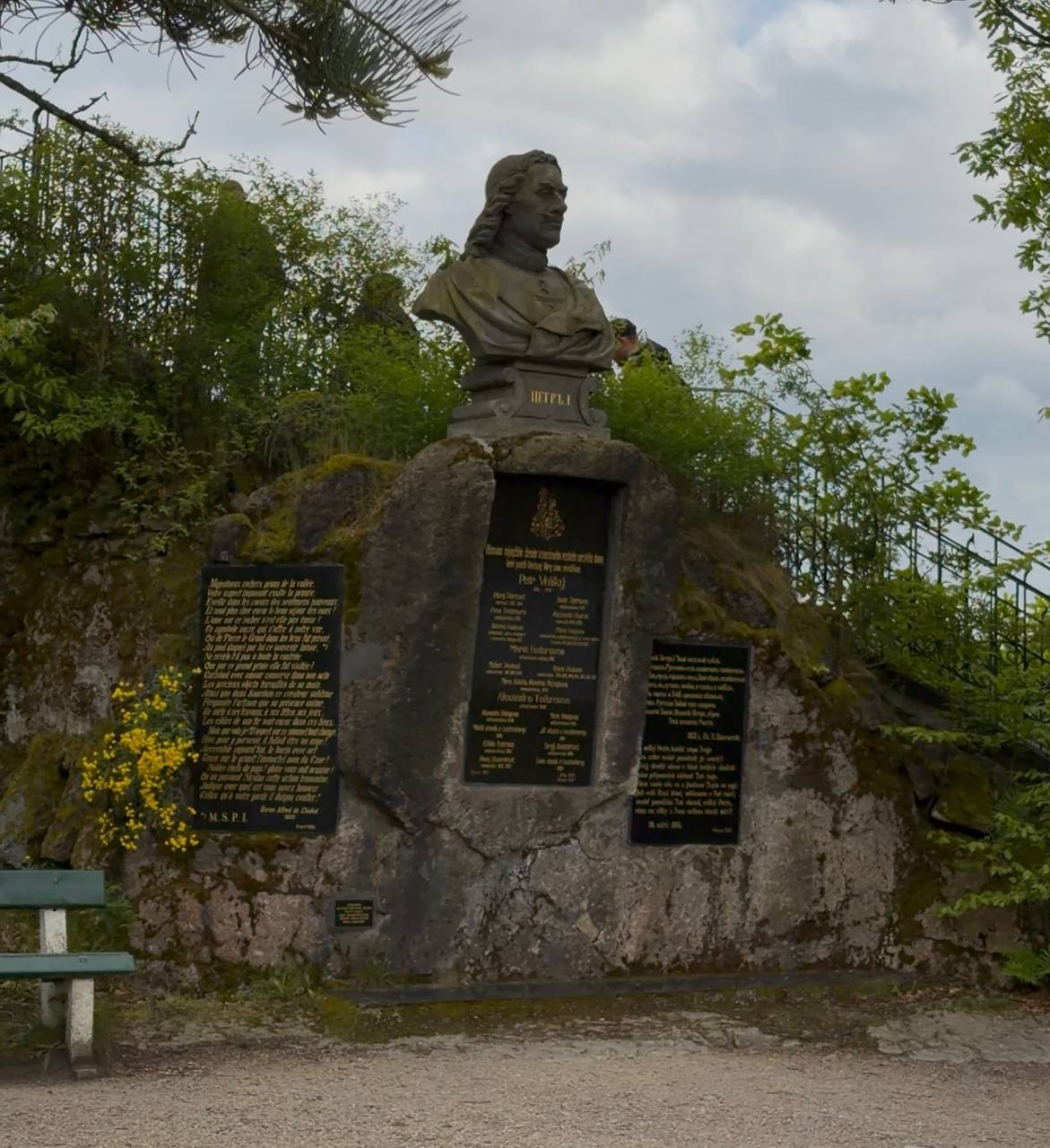
Stop 1: Peter the Great Lookout (Výhlídka Petra Velikého)
The first stop is the Peter the Great Lookout. According to historical records, on 11 November 1712, Russian Tsar Peter I rode up this steep rocky slope on an unsaddled horse for a bet — during his second visit to the spa. The path has carried his name ever since.
The road to Peter’s Summit above Deer Jump was created back in the 18th century. From the platform, you look down on the spa centre of the city in the valley of the Teplá river — the grand hotels, the colonnades, the church spires. If this is your first time in Karlovy Vary, this view explains everything: why emperors came here, why writers came here, why people have been making the journey for 600 years. The place looks like a film set.
Linger here — there are benches, and almost no one else around. Best light for photography: morning and late afternoon, when the sun falls along the valley.
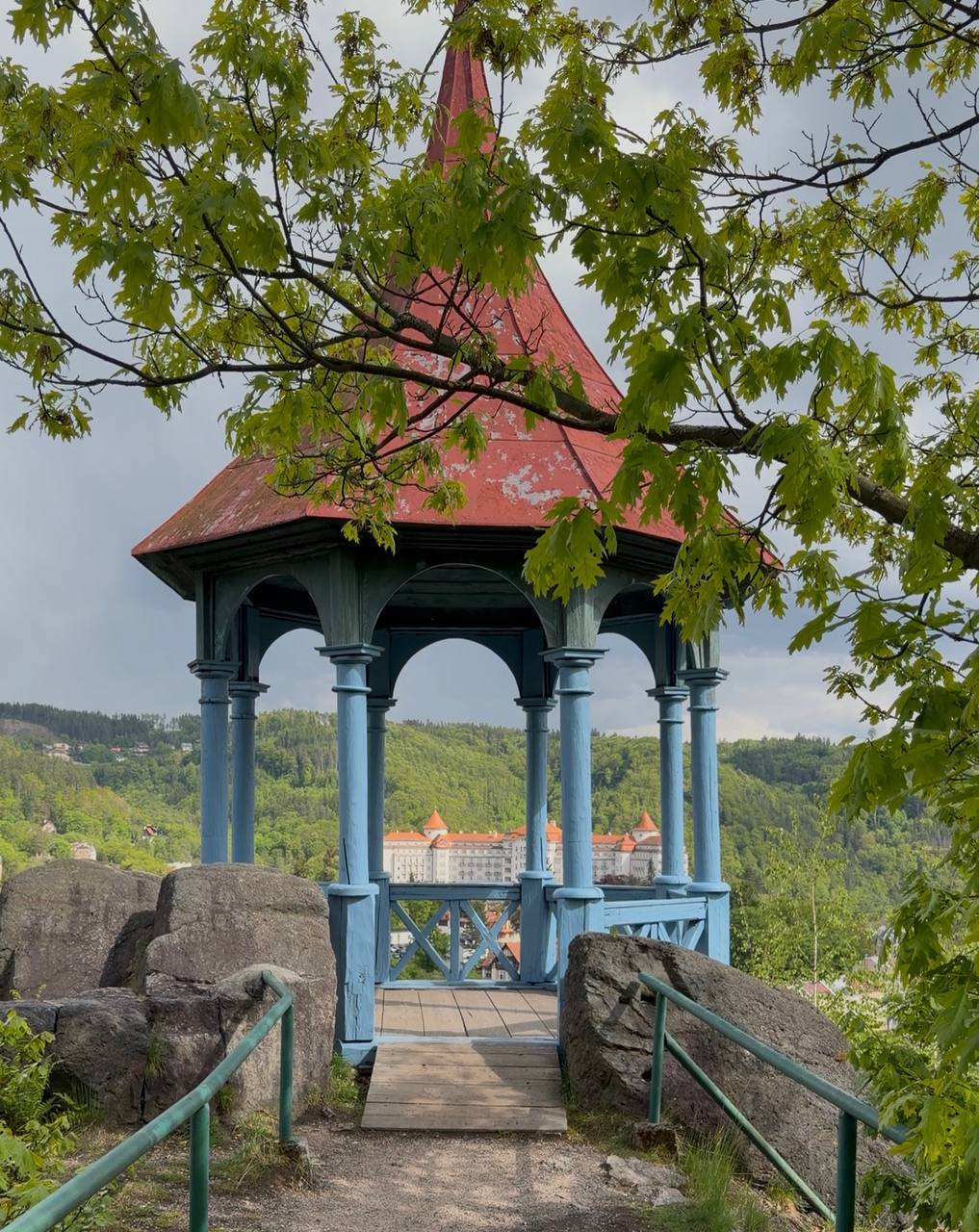
Stop 2: Mayer’s Gloriette (Mayerův gloriet)
A few minutes further along the trail — Mayer’s Gloriette. This is most likely the oldest viewpoint on the whole resort: a wooden pavilion built in 1804 by a wealthy Viennese merchant named Mayer, who was originally from Karlovy Vary. He had it constructed on the rocky outcrop above the Deer Jump as a thank-you of sorts — to the city and the waters that had made him prosperous.
The gloriette is small, wooden, almost toy-like against the backdrop of the forest. Tourists rarely find it — most walk straight past the turning towards Deer Jump without noticing it.
This is the place to stop not for the view, but for the feeling. Silence. The smell of the forest. Old wooden planks underfoot. This is what people come to Karlovy Vary for — and what no tourist brochure shows.
Tip: if you’re in no hurry, this is the place to sit for ten minutes. You won’t want to leave.
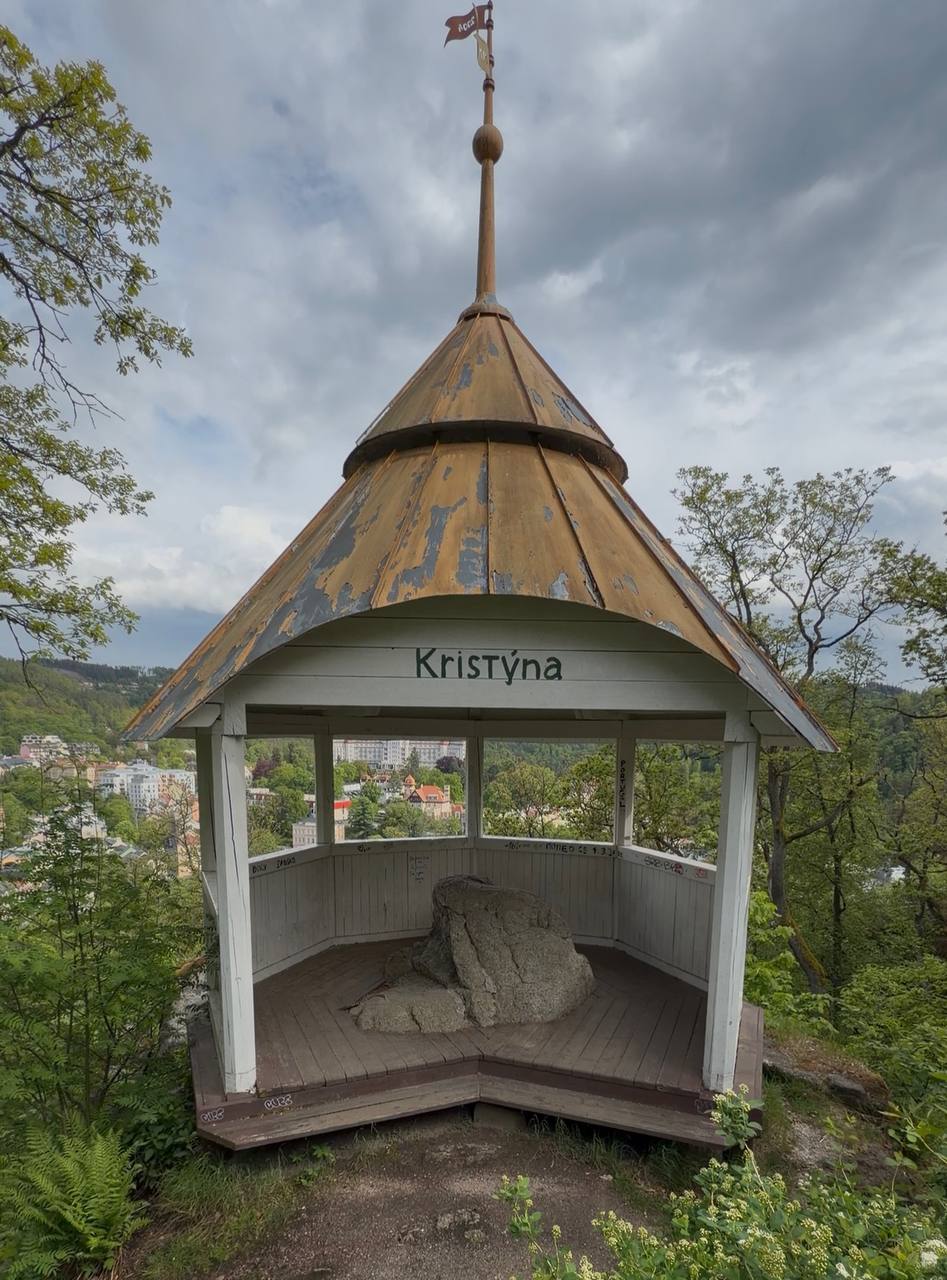
Stop 3: Kristýna Lookout (Výhlídka Kristýna)
Continue along the trail — the next stop is Kristýna Lookout. Less known than Deer Jump, and for exactly that reason more interesting. No tour groups, no queue for the photo spot.
From here, the view opens onto a different part of the city — the western side of the valley, invisible from every other point on this route. If you want to photograph Karlovy Vary from multiple angles, Kristýna gives you the shot that’s missing from most tourist galleries of the city.
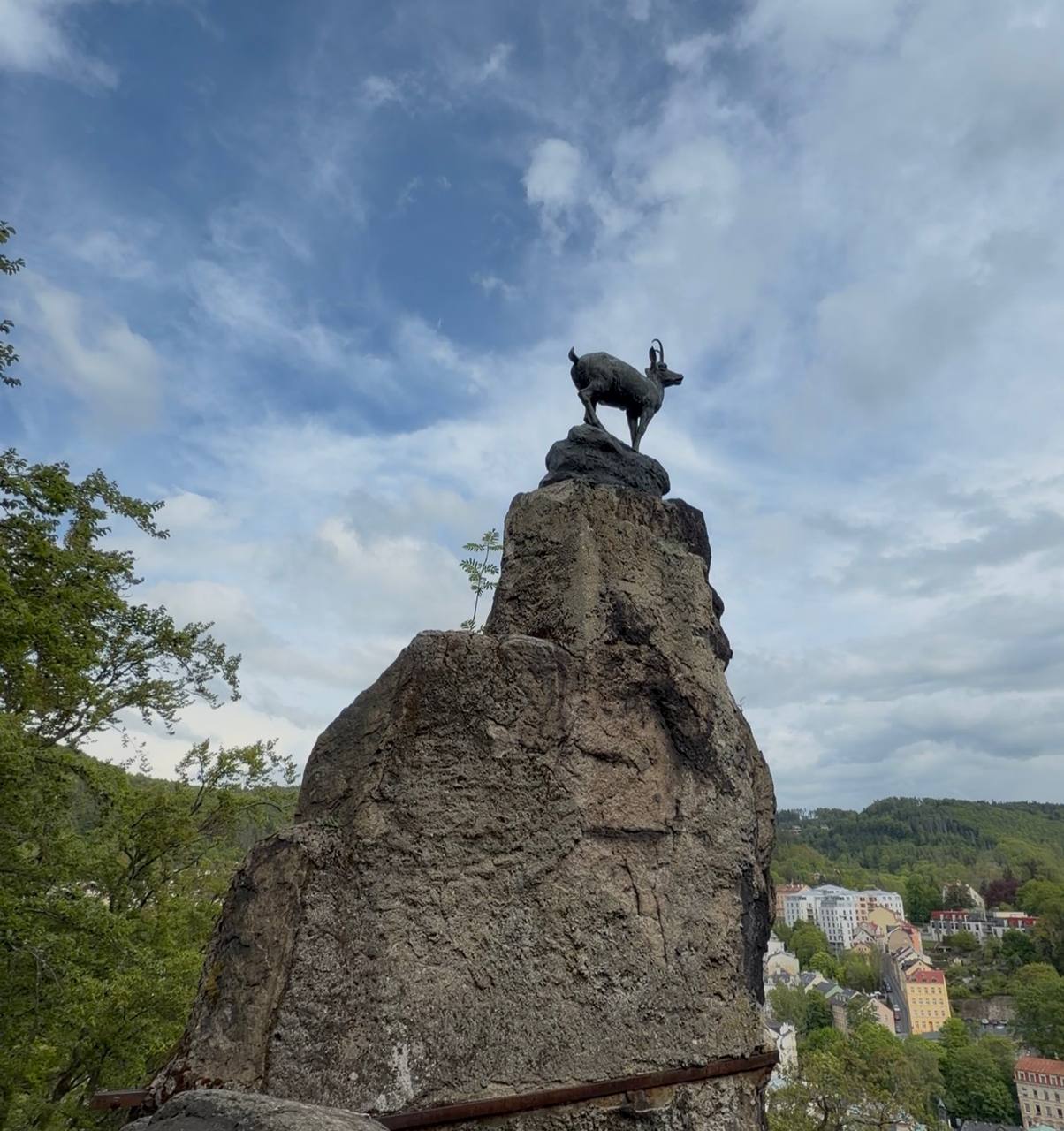
Stop 4: Deer Jump Lookout (Jelení skok) — The Final View
The last and most famous stop on the route — Deer Jump Lookout (Jelení skok). The city of Karlovy Vary grew in this valley thanks to Emperor Charles IV, who — according to legend — was chasing a deer during a hunt and stumbled upon a hot spring. On the platform stands a statue of that legendary animal.
Or rather, a statue of a chamois — and that’s its own story. The chamois is inseparable from Karlovy Vary. It was commissioned by Baron August Friedrich Ulrich von Lützow, who asked his friend August Kiss to sculpt it. It was a deliberate provocation that worked perfectly: every visitor looks at the sign reading “Deer Jump” and then stares at the chamois with mild confusion. That was exactly the point.
From the platform — a full panorama of the city centre. The Teplá river. Grandhotel Pupp. The green hills all around. This is the view the whole walk was building towards.
Practical note: 126 steps lead up to the Deer Jump platform from below. We’re approaching from above — so the descent is gradual.
Finish: Down to Grandhotel Pupp
From Deer Jump, descend to the street Pod Jelením skokem (Below Deer Jump) and turn right — towards Grandhotel Pupp. The path leads downhill through a shaded avenue, past several early 20th-century villas. Around 10–15 minutes at a comfortable pace.
Grandhotel Pupp is the finish line. One of the oldest and most celebrated hotels in Central Europe, it first opened in 1701. Even if you’re not staying here — step inside the lobby. The interior is worth seeing. Outside, it’s the perfect spot for a final photograph.
Optional Extension: Funicular and Diana Tower
If you still have energy and inclination — the funicular to Diana Tower (Rozhledna Diana) departs from near the Pupp. The funicular was built in 1909; the tower and hunting lodge were added in 1912–1914. From the top, the view extends across the entire region — not just the valley.
The funicular ride is paid; access to the observation platform on the tower itself is free. Deer Jump is an intermediate stop on the funicular line — if your legs are tired, you can ride up to Deer Jump rather than walking, take in the view, and continue to Diana without descending on foot.
Practical Information
Duration: the full route from Market Colonnade to Pupp takes approximately 1 hour 15 minutes at an average pace. With stops and photography — 1.5 to 2 hours.
Footwear: closed, comfortable shoes are essential. The path is forest trail — roots, potentially wet ground after rain. Sandals or heels are not advised.
Water: bring some. There are no cafés or springs on the trail itself — only at the start near the colonnade and at the end near the Pupp.
Best time: before 10am and after 5pm — fewer people at the final viewpoints, better light for photography. On weekends between 11am and 4pm, small groups do appear at Deer Jump.
Weather: the route runs mostly under tree cover — cooler than the city below in summer heat. In rain, the trail becomes slippery; better to postpone.
Dogs: the route works well for a walk with a dog. Forest, minimal crowds, no traffic.
What to Bring
Comfortable closed shoes — non-negotiable
Water — at least 0.5 litres
Charged phone — the views are worth it
A spa drinking cup — if you’d like to start the walk with a glass of mineral water at the colonnade
Why This Route Is Better Than the Standard Tourist Options
Most guides offer two choices: walk the colonnades at ground level, or take the funicular up to Diana. Both are worthwhile. But the forest walking route gives something neither of them can: the feeling that you discovered the city yourself.
Four viewpoints with different perspectives and different histories. Forest instead of tourist crowds. A wooden gloriette from 1804 where you can genuinely sit in silence. Views over the city seen by Peter the Great, Goethe, Beethoven, Schiller — all of them walked these hills.
This is the real Karlovy Vary. Not just the springs.
FAQ
Is the route suitable for children? Yes, if the child walks confidently and isn’t bothered by uneven forest paths. Not suitable for pushchairs — the trail is rough.
Can you walk the route in reverse? Yes. Starting from the Pupp and climbing through the forest is slightly more physically demanding, but you reach Deer Jump as your first stop.
How much does the Diana funicular cost? Current prices are posted at the ticket office near Grandhotel Pupp, or on the funicular’s website. The tower observation platform is free of charge.
Are there toilets on the route? At the start — near the Market Colonnade. At the finish — near Grandhotel Pupp. On the trail itself — no.
What’s the best season? Spring and summer — lush and green, beautiful. Autumn — the foliage makes the viewpoints particularly striking. In winter the trail can be icy, but the views over a snow-covered city are something else entirely.
movieRecommended after a walk around the city
Discover the secrets of Karlovy Vary in the film “The Power of Water”
A unique documentary film about thermal springs, the history of the resort, healing water and why Karlovy Vary became one of the most famous spa towns in Europe.
alarm60 minutes in Russian, English, German and Czech
calendar_monthScreenings daily at 16:00 and 20:00
location_onCinema hall in the center, next to the Mill Colonnade